

Cleopatra VII died by suicide in her guarded mausoleum in Alexandria on 10 or 12 August 30 BC, aged 39, shortly after Octavian’s forces captured the city, but no eyewitness recorded how did Cleopatra die. Although popular culture treats a smuggled cobra bite as settled history, our earliest surviving source, the geographer Strabo, noted that contemporary accounts split between a venomous snakebite and an applied poisonous ointment.
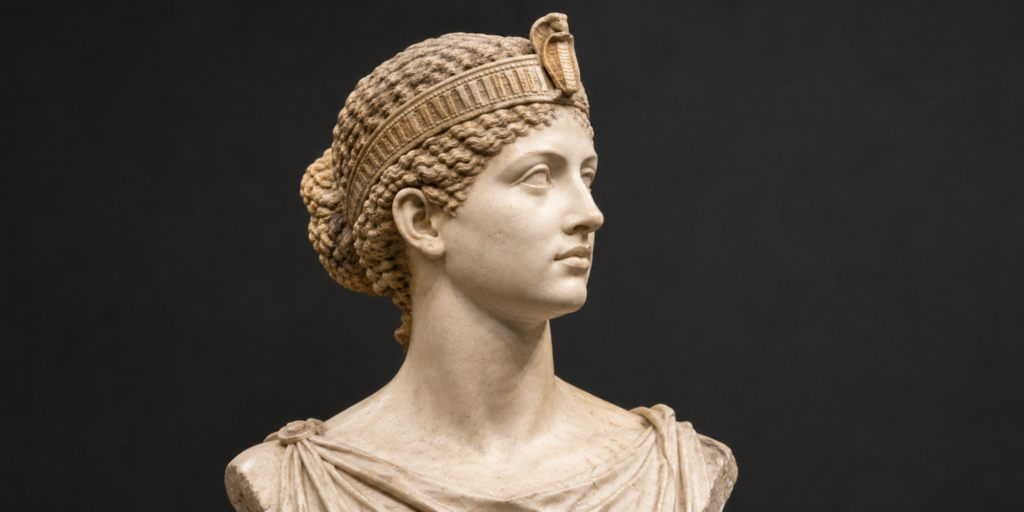
The Berlin Cleopatra, a contemporary Roman marble portrait sculpted between 40 and 30 BC, shows the queen wearing the broad royal diadem of the Ptolemaic dynasty (Altes Museum, Antikensammlung, Staatliche Museen zu Berlin, Inv. Sk 1822).
The popular image of the smuggled asp
Ask almost anyone how Cleopatra died, and the answer is a single dramatic tableau: an Egyptian cobra, or asp, smuggled past Roman guards inside a basket of figs and pressed against the queen’s chest or arm. The scene dominates Western theatre, European painting, and cinema, most famously through William Shakespeare’s Antony and Cleopatra (first performed around 1606–1607) and Joseph L. Mankiewicz’s 1963 film Cleopatra. In these retellings, the snake is both a murder weapon and a royal statement. Because the uraeus — the rearing Egyptian cobra worn on the brow of pharaohs — symbolised divine royalty and the protection of the sun god Ra, dying by the bite of a sacred serpent allowed Cleopatra to stage an apotheosis rather than submit to humiliation in Rome.
In popular retellings, her two attendant women, Iras and Charmion, die alongside her in the same room within minutes, presumably struck by the same reptile or sharing its venom. Modern museum labels, school textbooks, and television documentaries regularly repeat the fig-basket story without qualification. Yet this familiar narrative treats a symbolic Roman rumour as a forensic record. As Stacy Schiff and Joyce Tyldesley both emphasize in their biographies of the queen, the canonical death scene blends propagandistic poetry from Augustan Rome with details first committed to writing by Greek historians more than a century after 30 BC.
How Augustan poetry shaped the snakebite story
The snakebite narrative solidified in Rome immediately after the fall of Ptolemaic Egypt after Actium, long before detailed narrative histories were written. When Octavian celebrated his triple triumph in Rome in August 29 BC, Cleopatra could not be marched in chains alongside the captured children of Antony and the doomed Caesarion. Instead, Octavian paraded a life-size effigy of the dead queen with an asp clinging to her arm. For Roman spectators lining the procession route, that triumphal float fixed the visual memory of her suicide: the eastern monarch defeated by Rome, felled by the creature of her own royal iconography.
Augustan poets reinforced the image within years of the triumph. Horace’s Odes (1.37), composed shortly after the news reached Italy in 30 BC, depicted the queen fiercely drinking in the “black venom” of serpents so she would not be led as a private woman in a proud triumph. Writing in the next decade, Propertius (Elegies 3.11) claimed he had watched her arms bitten by sacred snakes during the triumphal parade — a reference to the painted or sculpted effigy rather than a living prisoner — while Virgil (Aeneid 8.697) portrayed twin snakes looming behind her already at the naval battle of Actium.
Because no Roman soldier was inside the locked chamber inside the royal quarters of Alexandria when Cleopatra died, these poets were not reporting an autopsy. They were crafting imperial imagery for Octavian’s regime, turning a private, unseen suicide behind bolted doors into a public spectacle of venomous eastern exoticism.
What the ancient accounts actually record
Only three major narrative sources describe the death in detail, and none claims certainty. The earliest is the Greek geographer Strabo, who visited Alexandria in the entourage of the Roman prefect Aelius Gallus around 25 BC, just five years after the event. In his Geography, Strabo states that Cleopatra died secretly in prison either from the bite of an asp or by applying a poisonous ointment, adding explicitly that “both stories are told”.
Writing over a century later around AD 110, Plutarch provided the fullest account in his Life of Antony (85–86), drawing in part on memoirs attributed to Cleopatra’s physician Olympus. Even Plutarch refused to endorse a single version, writing that “the truth of the matter no one knows”. He recorded that some said an asp was brought in with figs covered in leaves, others said she kept the snake in a water pitcher (hydria) and provoked it with a golden spindle, and still others said she carried fast-acting poison inside a hollow hairpin (knestis) hidden in her hair. Cassius Dio, writing in the early third century AD (Roman History 51.14), similarly noted that nobody knew clearly how she died, mentioning only slight pricks on her arm and suspecting either a water-jar snake or a poisoned hairpin.
| Ancient Author | Work and Approximate Date | Proposed Cause(s) of Death | Reported Physical Signs on Body |
| Strabo | Geography (17.1.10), c. 20s BC – AD 20s | Bite of an asp OR application of a poisonous ointment (pharmakon) | None specified |
| Plutarch | Life of Antony (86), c. AD 110 | Asp in fig basket, asp in pitcher, OR poison inside a hollow hairpin | No bodily marks or signs of poison; only faint pricks on the arm |
| Cassius Dio | Roman History (51.14), c. AD 210–230 | Reptile brought in water jar OR poisoned needle/hairpin smeared with venom | Slight pricks (kentemata lepta) on the arm; body otherwise unharmed |
Why historians and toxicologists remain divided
Modern historians and medical researchers remain divided because the clinical symptoms described by Plutarch and Cassius Dio conflict with the biology of the Egyptian cobra (Naja haje). An adult Egyptian cobra typically reaches 1.5 to 2.4 metres in length, making it difficult to conceal inside a small basket of figs or a water jar without detection by Roman sentries inspecting everyone entering the mausoleum. Moreover, cobra bites are neither guaranteed to be fatal nor consistently painless: a high proportion of defensive snake strikes are “dry” bites that inject no venom, and fatal neurotoxic envenomation typically causes localised swelling, tissue necrosis, and hours of respiratory distress rather than instantaneous, Simultaneous collapse.
In a 2010 analysis, the German historian Christoph Schäfer, after consulting toxicologist Dietrich Mebs, argued that a single cobra could not have killed Cleopatra, Iras, and Charmion rapidly inside the locked chamber while leaving no swelling or discoloration on the queen’s corpse. Schäfer and Mebs proposed instead that the three women drank a lethal cocktail combining hemlock, wolfsbane (Aconitum), and opium — substances well documented in Hellenistic toxicological treatises and consistent with Plutarch’s earlier statement (Antony 71.4–5) that Cleopatra had tested painless poisons on condemned prisoners.
Classicists such as Griffiths (1961) and Gurval (2011) counter that ancient logistical objections do not entirely rule out a reptile, noting that the deep symbolic connection between the cobra and Ptolemaic queenship gave Cleopatra a powerful political motive to stage a serpent death if she could. Unless Cleopatra’s tomb is discovered with preserved skeletal or toxicological remains — a prospect complicated by coastal subsidence in Alexandria — no physical test can settle the dispute.
Separating Augustan triumphal theatre from our surviving textual record transforms how we read the end of the Ptolemaic dynasty. When we treat the asp as a historical fact, we adopt the exact visual narrative Octavian staged in 29 BC to explain why Rome’s most dangerous rival had slipped through his fingers alive. Reading Strabo, Plutarch, and Cassius Dio side by side reveals a far more calculated reality: behind the locked doors of her monument, a ruler well versed in Hellenistic pharmacology engineered a death so swift and unblemished that even her captors had to invent the weapon.
References
Primary sources
- Strabo, Geography, Volume VIII: Book 17 and General Index, trans. Horace Leonard Jones, Loeb Classical Library 267 (Cambridge, MA: Harvard University Press, 1932), 17.1.10, pp. 40–43. DOI: 10.4159/DLCL.strabo-geography.1917.
- Plutarch, Lives, Volume IX: Demetrius and Antony, Pyrrhus and Gaius Marius, trans. Bernadotte Perrin, Loeb Classical Library 101 (Cambridge, MA: Harvard University Press, 1920), Antony 71.4–5, 85–86, pp. 300–303, 326–331. DOI: 10.4159/DLCL.plutarch-lives_antony.1920.
- Cassius Dio, Roman History, Volume VI: Books 51–55, trans. Earnest Cary and Herbert B. Foster, Loeb Classical Library 83 (Cambridge, MA: Harvard University Press, 1917), 51.11–14, pp. 32–41. DOI: 10.4159/DLCL.dio_cassius-roman_history.1914.
Secondary sources
- J. Gwyn Griffiths, “The Death of Cleopatra VII,” The Journal of Egyptian Archaeology 47 (1961): 113–118. DOI: 10.2307/3855871.
- T. C. Skeat, “The Last Days of Cleopatra: A Chronological Problem,” The Journal of Roman Studies 43 (1953): 98–100. DOI: 10.2307/297786.
- Joyce Tyldesley, Cleopatra: Last Queen of Egypt (London: Profile Books, 2008).
- Robert A. Gurval, “Dying Like a Queen: The Story of Cleopatra and the Asp(s) in Antiquity,” in Cleopatra: A Sphinx Revisited, ed. Margaret M. Miles (Berkeley: University of California Press, 2011), pp. 54–77. DOI: 10.1525/9780520950269-006.
- Stacy Schiff, Cleopatra: A Life (New York: Little, Brown and Company, 2010).
- Christoph Schäfer, Kleopatra (Darmstadt: Wissenschaftliche Buchgesellschaft, 2006).
Further reading (not drawn on for this article)
- Duane W. Roller, Cleopatra: A Biography (Oxford: Oxford University Press, 2010).
- Michel Chauveau, Cleopatra: Beyond the Myth, trans. David Lorton (Ithaca, NY: Cornell University Press, 2002).
- Christopher Pelling, ed., Plutarch: Life of Antony (Cambridge: Cambridge University Press, 1988).