

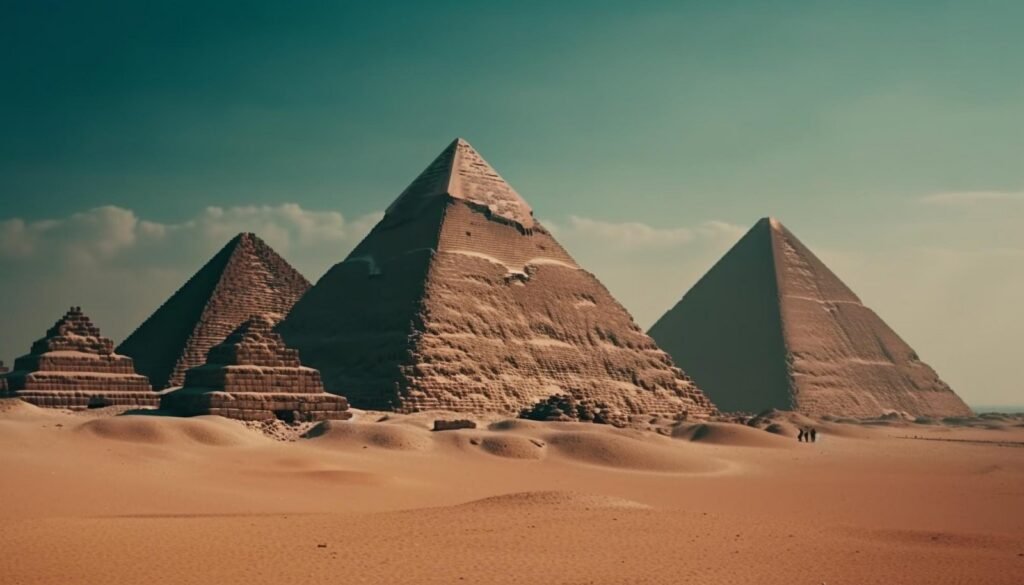
State-organised Egyptian work crews, not enslaved multitudes, built the pyramids of Giza during the Fourth Dynasty (Bronk Ramsey et al. 2010). Hieratic logbooks excavated at Wadi al-Jarf in 2013 and barracks uncovered at Heit el-Ghurab show that roughly 20,000 rotated labourers quarried, shipped and hauled the Great Pyramid’s 2.3 million limestone and granite blocks.
Stepped core masonry of the Great Pyramid of Khufu at Giza, photographed in 1894 after the loss of most of its outer Tura limestone casing (William Henry Jackson, Library of Congress, LOT 11948, no. 115).
The myth of enslaved multitudes at the Giza pyramids
Popular histories, cinema epics and older textbooks routinely depict the construction of Khufu’s tomb as an exercise in mass chattel slavery. In this standard account, a tyrannical pharaoh conscripted between 100,000 and 360,000 captives—frequently identified in Western cultural memory with the biblical Israelites—and drove them under the lash across desert sands to drag multi-tonne stone blocks up a single monumental mudbrick ramp.
The image persists because it offers an intuitive answer to a staggering logistical feat. Completed around 2560 BCE for the Fourth Dynasty ruler Khufu (whose accession Bayesian radiocarbon modelling places between 2613 and 2577 BCE), the Great Pyramid originally rose 146.6 metres on a base measuring 230.3 metres per side, as established by W. M. Flinders Petrie’s 1883 trigonometric survey of the plateau. In his 1997 synthesis of the Giza necropolis, Mark Lehner calculates that the monument contains approximately 2.3 million stone blocks averaging 2.5 tonnes apiece, with the largest granite beams over the King’s Chamber weighing between 50 and 80 tonnes. Confronted with a stone mountain of roughly 5.75 million tonnes erected in under three decades without iron tools, pulleys or wheeled vehicles (Stocks 2003), modern observers assumed that only disposable forced labour on a six-figure scale could have supplied the muscle.
How Greek and Roman writers invented the slave-labour story
The numbers behind the mass-labour narrative come not from Egyptian inscriptions, which never record a total headcount for Giza, but from classical travellers who visited the plateau more than two millennia after Khufu’s death. Around 450 BCE, the Greek historian Herodotus reported in Book 2 of The Persian Wars (2.124–125) what Egyptian priests and interpreters told him during the First Persian occupation: that King Cheops (Khufu) closed the country’s temples, forced all Egyptians to toil for him, and rotated levies of 100,000 men every three months for ten years to build the causeway and another twenty years to raise the royal tomb itself.
Four centuries later, the Sicilian Greek historian Diodorus Siculus repeated this portrait in his Library of History (1.63–64). Diodorus inflated the workforce to 360,000 men labouring for twenty years and claimed that popular fury over their hardships forced Khufu and his successor Khafre to seek secret burials lest the mob tear their corpses apart. Neither Herodotus nor Diodorus claimed the builders were foreign slaves; both described compulsory corvée imposed by an impious monarch on native Egyptian subjects.
The transformation of those conscripted peasants into enslaved Israelites occurred in the first century CE. In his Jewish Antiquities (2.201–204), the Romano-Jewish historian Flavius Josephus embellished the biblical book of Exodus—which names only the mudbrick storage cities of Pithom and Raamses—by asserting that the Egyptians wore down the Hebrews by setting them to cut canals, wall cities and erect royal funerary monuments. Early modern European travellers and nineteenth-century painters such as Adrien Dauzats inherited a tradition that fused Herodotus’s 100,000-man levy with Josephus’s gloss, turning Late Period folklore about Fourth Dynasty royal administration (unpublished — slug: old-kingdom-egypt-state-administration) into an enduring historical orthodoxy.
What Merer’s logbook and the Giza excavations prove
Archaeological and textual discoveries at Giza and on the Red Sea coast have dismantled both the slavery myth and Herodotus’s six-figure workforce. In 2013, Pierre Tallet and Gregory Marouard excavated hundreds of hieratic papyrus fragments sealing storage galleries at Wadi al-Jarf, a Fourth Dynasty port on the Gulf of Suez Wadi al-Jarf harbour. Published in Tallet’s 2017 edition, Papyrus Jarf A and B—the Diary of Merer—preserve the daily logbooks of Inspector Merer (sḥḏ Mrr) from the year after Khufu’s thirteenth cattle census (Year 26).
Merer led a za (phyle) of roughly 40 boatmen who hauled fine white limestone (jnr ḥḏ) from Tura North and Tura South and shipped it downstream to Akhet-Khufu (“Horizon of Khufu”), the Great Pyramid, via the basin of Ro-She Khufu under Khufu’s half-brother and vizier Ankhhaf . Far from being mistreated captives, Merer’s crew received monthly rations from Heliopolis, including “40 sacks-khar and a large measure-heqat of bread-beset” (Tallet 2017, p. 150). At Giza’s Heit el-Ghurab workers’ town, Mark Lehner’s excavations uncovered mudbrick galleries housing 1,600 to 2,000 rotating workers alongside bakeries and cattle slaughterhouses, supporting Lehner and Zahi Hawass’s 2017 estimate of 20,000 total workers—including roughly 4,000 at the plateau site itself.
How did Merer’s crew deliver limestone to the Great Pyramid?
| Stage | Location in Papyrus Jarf A–B | Operational record (Tallet 2017, pp. 150–161) |
| Quarrying | Tura North and Tura South | ~40 boatmen hauled white casing blocks to Nile quays on ten-day cycles. |
| Transit | Nile and Ro-She Khufu | Cargo boats sailed downstream during the July–November flood under Vizier Ankhhaf. |
| Delivery | Akhet-Khufu (Giza) | Two to three round trips every ten days moved ~200 blocks monthly. |
What remains uncertain about raising the stone
While provisioning and river transport are now securely documented, the exact engineering method used to haul 2.3 million blocks up the rising superstructure remains unresolved. In 2022, palaeoecological analysis of floodplain sediment cores by Hader Sheisha and colleagues confirmed that a now-defunct western Nile channel—the Khufu branch—maintained high water levels (~40 per cent of its Holocene maximum) during the Fourth Dynasty, allowing barges to dock at basins cut against the foot of the Giza plateau. What happened after the stones left the quayside is where the primary record falls silent: as Tallet notes in his 2017 synthesis (p. 151), Merer’s logbooks stop at the unloading basins and never mention construction ramps.
No single ramp configuration commands consensus among Egyptologists and engineers. Somers Clarke and R. Engelbach demonstrated in 1930, and I. E. S. Edwards reiterated in 1947, that a single straight mudbrick ramp reaching the 146.6-metre summit at a workable gradient would have exceeded the volume of the monument itself and run beyond the available quarry footprint. Dieter Arnold’s 1991 masonry study and Lehner’s 1997 terrain models instead favour a wrap-around or spiralling exterior ramp banked against the stepped core, whereas Denys A. Stocks’s 2003 experiments highlight the severe friction and corner-turning limits of wooden sledges on steep inclines. Until non-destructive muography or new Fourth Dynasty administrative papyri reveal internal density anomalies or builders’ specifications, the upper-level lifting system cannot be settled.
Tracing the Great Pyramid’s construction through Fourth Dynasty administrative records replaces a moral fable of tyrannical slavery with a clearer picture of early state capacity. The monument was possible not because Khufu commanded an inexhaustible supply of disposable bodies, but because Old Kingdom bureaucracy mastered seasonal hydrology, standardised phyle rotation and central provisioning (Roth 1991). Merer’s logbooks show that the decisive achievement at Giza was fiscal and logistical coordination: synchronising quarrymen at Tura, boat crews on the flooded Nile, and masons on the plateau so that stone, bread and meat arrived on schedule across twenty-six regnal years.
References
Primary sources
- Pierre Tallet, Les papyrus de la mer Rouge I: Le « journal de Merer » (Papyrus Jarf A et B), Mémoires publiés par les membres de l’Institut français d’archéologie orientale 136 (Cairo: Institut français d’archéologie orientale, 2017), pp. 150–161, https://www.ifao.egnet.net/recherche/archeologie/ouadi-el-jarf/ (English translation of Annexe I at https://amers.hypotheses.org/wp-content/blogs.dir/2495/files/2017/03/1705_Tallet.pdf).
- W. M. Flinders Petrie, The Pyramids and Temples of Gizeh (London: Field & Tuer, 1883), https://giza.fas.harvard.edu/pubdocs/551/full/.
- Herodotus, The Persian Wars, Volume I: Books 1–2, trans. A. D. Godley, Loeb Classical Library 117 (Cambridge, MA: Harvard University Press, 1920), Book 2, chs. 124–128, https://www.loebclassics.com/abstract/LCL117/1920/volume.xml.
- Diodorus Siculus, Library of History, Volume I: Books 1–2.34, trans. C. H. Oldfather, Loeb Classical Library 279 (Cambridge, MA: Harvard University Press, 1933), Book 1, chs. 63–64, pp. 215–223, https://www.loebclassics.com/abstract/LCL279/1933/volume.xml.
- Flavius Josephus, Jewish Antiquities, Volume I: Books 1–3, trans. H. St. J. Thackeray, Loeb Classical Library 242 (Cambridge, MA: Harvard University Press, 1930), Book 2, ch. 9 (2.201–204), https://www.loebclassics.com/abstract/LCL242/1930/volume.xml.
Secondary sources
- Somers Clarke and R. Engelbach, Ancient Egyptian Masonry: The Building Craft (London: Oxford University Press, 1930), https://catalog.hathitrust.org/Record/000664294.
- I. E. S. Edwards, The Pyramids of Egypt (Harmondsworth: Penguin Books, 1947), https://countryhouselibrary.co.uk/products/the-pyramids-of-egypt-by-i-e-s-edwards-pelican-1947.
- Dieter Arnold, Building in Egypt: Pharaonic Stone Masonry (New York: Oxford University Press, 1991), https://www.cambridge.org/core/journals/antiquaries-journal/article/building-in-egypt-pharaonic-stone-masonry-by-dieter-arnold-287-223mm-pp-316-many-ills-oxford-oxford-university-press-1991-isbn-0195063503-6000/5C1A0614E177E2BEB26DF735866EEDEB.
- Ann Macy Roth, Egyptian Phyles in the Old Kingdom: The Evolution of a System of Social Organization, Studies in Ancient Oriental Civilization 48 (Chicago: Oriental Institute of the University of Chicago, 1991), pp. 32, 120, https://doi.org/10.83354/emjz-xg21.
- Mark Lehner, The Complete Pyramids (London: Thames and Hudson, 1997), pp. 108–109, 206–209, 215–217, 224–225, https://www.abebooks.co.uk/9780500050842/Complete-Pyramids-Mark-Lehner-0500050848/plp.
- Mark Lehner, “The Pyramid Age Settlement of the Southern Mount at Giza,” Journal of the American Research Center in Egypt 39 (2002): 27–74, https://doi.org/10.2307/40001149.
- Denys A. Stocks, Experiments in Egyptian Archaeology: Stoneworking Technology in Ancient Egypt (London: Routledge, 2003), https://www.routledge.com/Experiments-in-Egyptian-Archaeology-Stoneworking-Technology-in-Ancient-Egypt/Stocks/p/book/9781032217574.
- Dietrich Klemm and Rosemarie Klemm, The Stones of the Pyramids: Provenance of the Building Stones of the Old Kingdom Pyramids of Egypt (Berlin: De Gruyter, 2010), pp. 51–59, 87–89, https://www.abebooks.it/9783110221237/Stones-Pyramids-Provenance-Building-Old-3110221233/plp.
- Pierre Tallet and Gregory Marouard, “The Harbor of Khufu on the Red Sea Coast at Wadi al-Jarf, Egypt,” Near Eastern Archaeology 77, no. 1 (2014): 4–14, https://doi.org/10.5615/neareastarch.77.1.0004.
- Mark Lehner, “Labor and the Pyramids: The Heit el-Ghurab ‘Workers Town’ at Giza,” in Labor in the Ancient World, ed. Piotr Steinkeller and Michael Hudson (Dresden: ISLET-Verlag, 2015), pp. 397–522, esp. pp. 432–438, https://aeraweb.org/publications/aera-bibliography/.
- Mark Lehner and Zahi Hawass, Giza and the Pyramids: The Definitive History (Chicago: University of Chicago Press, 2017), https://press.uchicago.edu/ucp/books/book/chicago/G/bo25022565.html.
- Hader Sheisha et al., “Nile waterscapes facilitated the construction of the Giza pyramids during the 3rd millennium BCE,” Proceedings of the National Academy of Sciences 119, no. 37 (2022): e2202530119, https://doi.org/10.1073/pnas.2202530119.
Further reading (not drawn on for this article)
- Miroslav Verner, The Pyramids: The Mystery, Culture, and Science of Egypt’s Great Monuments (New York: Grove Press, 2001), https://www.abebooks.com/9780802117038/Pyramids-Mystery-Culture-Science-Egypts-0802117031/plp.
- Dieter Arnold, “Überlegungen zum Problem des Pyramidenbaues,” Mitteilungen des Deutschen Archäologischen Instituts, Abteilung Kairo 37 (1981): 15–28, https://archive.org/download/egyptology-archive-vol.-37-1981/EGYPTOLOGY%20ARCHIVE%20Vol.%2037%20%281981%29.pdf.