

Ancient Egypt was the northeast African riverine civilisation that flourished along the lower reaches of the Nile Valley and Delta from its political unification around 3100 BC until its annexation as a province of Rome in 30 BC. Across three millennia and thirty-one royal dynasties, it developed one of the ancient world’s most enduring administrative states, monumental stone architectures, and literary religious traditions. Beyond royal funerary masks and temple reliefs, excavated workers’ bakeries at Giza, Fourth Dynasty Red Sea logbooks, and a twelfth-century BC strike register from Thebes reveal the paid artisans and scribes who actually built the kingdom.
Key facts
- Dates: c. 3100 BC (unification of Upper and Lower Egypt under the First Dynasty) – 30 BC (death of Cleopatra VII and Roman annexation)
- Capitals: Memphis (Early Dynastic and Old Kingdom), Thebes / Waset (Middle and New Kingdoms), Itjtawy (Twelfth Dynasty), Amarna / Akhetaten (reign of Akhenaten), Pi-Ramesses (Nineteenth Dynasty), Tanis, Sais, and Alexandria (Late and Ptolemaic Periods)
- Key rulers: Narmer (c. 3100 BC), Djoser (c. 2667–2648 BC), Khufu (c. 2589–2566 BC), Mentuhotep II (c. 2055–2004 BC), Hatshepsut (c. 1473–1458 BC), Thutmose III (c. 1479–1425 BC), Akhenaten (c. 1352–1336 BC), Ramesses II (r. 1279–1213 BC), Cleopatra VII (r. 51–30 BC)
- Peak size and population: Approximately 1 million square kilometres under the New Kingdom empire (stretching from the Fourth Cataract in Nubia to northern Syria); estimated population of 3 million to 5 million in the New Kingdom, rising to 5 million to 7 million in the Graeco-Roman period
- Outcome: Absorbed iteratively by the Kushite, Assyrian, Achaemenid Persian, and Macedonian empires before becoming a province of Rome in 30 BC
Ancient Egypt geography: The Nile and the three kingdoms
Understanding ancient Egypt geography begins with the sharp ecological division that Egyptians called the dichotomy between Kemet (the “Black Land” of dark, alluvial Nile silt) and Deshret (the “Red Land” of the surrounding Sahara and Arabian deserts). For more than a thousand kilometres between the granite boulders of the First Cataract at Aswan and the Mediterranean coast, human settlement was confined to a narrow riverine ribbon rarely wider than twenty kilometres, opening north of Memphis into the triangular fan of the Nile Delta.
How the Nile shaped unification and early dynasties
Every summer, monsoon rains falling on the Ethiopian highlands caused the Blue Nile and Atbara rivers to swell, driving an annual inundation (Akhet) that reached Aswan in June and inundated the Egyptian floodplain through September. When the floodwaters receded in October, they left behind fresh, nitrogen-rich silt and washed away destructive soil salts, allowing farmers to sow emmer wheat, six-row barley, and flax without artificial fertiliser. Because Upper Egypt (the narrow southern valley from Aswan to Memphis) sat upstream of Lower Egypt (the marshy northern Delta), Egyptian spatial orientation faced south: “up” meant travelling against the current toward Nubia, while the prevailing north wind allowed boats with raised sails to travel south against the river flow.
As Toby Wilkinson traces in The Rise and Fall of Ancient Egypt (2010), increasing aridity across the Sahara during the fourth millennium BC pushed pastoral communities into the Nile trough, where competing Predynastic chiefdoms coalesced around centres such as Hierakonpolis (Nekhen), Naqada, and Abydos. Around 3100 BC, southern rulers completed the political unification of the Two Lands (Tawy). That milestone was commemorated on ceremonial monuments such as the Narmer Palette, discovered at Hierakonpolis in 1897–1898, which shows King Narmer wearing the bowling-pin-shaped White Crown of Upper Egypt on one side and the flat-topped Red Crown of Lower Egypt on the reverse. Founding a central capital at Memphis at the apex of the Delta, Early Dynastic kings (First and Second Dynasties, c. 3000–2686 BC) established royal monopolies over Sinai copper mines, standardised hieroglyphic tax tallies, and built massive mud-brick funerary enclosures at Abydos and Saqqara.
The Old, Middle and New Kingdoms
Following the framework devised in the third century BC by the Egyptian priest Manetho, historians divide pharaonic history into three periods of centralised stability — the Old, Middle, and New Kingdoms — separated by three “Intermediate Periods” of political fragmentation. During the Old Kingdom (Third to Sixth Dynasties, c. 2686–2181 BC), the Memphite monarchy perfected provincial taxation and mobilised national corvée labour to erect the great stone pyramids of Saqqara, Dahshur, and Giza. By the late Sixth Dynasty, however, the long reign of Pepi II, the growing autonomy of hereditary provincial governors (nomarchs), and a series of low Nile floods fractured the country into the First Intermediate Period (c. 2181–2055 BC), when rival dynasties at Herakleopolis and Thebes fought for supremacy.
The Theban ruler Mentuhotep II reunited the country around 2055 BC, inaugurating the Middle Kingdom (Eleventh to Thirteenth Dynasties, c. 2055–1650 BC). Under Twelfth Dynasty monarchs such as Senusret III and Amenemhat III, the court relocated to Itjtawy near the Faiyum Oasis, reclaimed tens of thousands of hectares of marshland for agriculture, conquered Lower Nubia down to the Second Cataract, and fostered the golden age of Middle Egyptian literature. When Canaanite rulers known as the Hyksos (heqau-khasut, “rulers of foreign lands”) took control of the eastern Delta from their capital at Avaris during the Second Intermediate Period (c. 1650–1550 BC), they introduced the horse-drawn light chariot, the composite bow, and bronze sickle-swords into the Nile Valley.
Expelling the Hyksos around 1550 BC, the Theban king Ahmose I founded the Eighteenth Dynasty and launched the New Kingdom (Eighteenth to Twentieth Dynasties, c. 1550–1069 BC) — Egypt’s imperial age. Armed with chariotry and a professional standing army, pharaohs such as Thutmose I and Thutmose III pushed Egyptian control south to the Fourth Cataract in Nubia and north to the Euphrates River in Syria, while Queen Hatshepsut dispatched maritime trading fleets down the Red Sea to the Land of Punt. Even after the religious upheaval of Akhenaten (Amenhotep IV, r. 1352–1336 BC), who elevated the sun-disc Aten and shifted the capital to Amarna, the restored monarchy under Tutankhamun, Horemheb, and the Ramesside Nineteenth Dynasty maintained Egypt’s status as the wealthiest superpower of the Late Bronze Age.
Pharaohs, Egypt Ramses the Great and the ancient economy of Egypt
At the summit of the state stood the pharaoh — a title derived from per-aa (“Great House”), originally designating the royal palace before coming to mean the monarch himself during the Eighteenth Dynasty — who governed through dual viziers, temple estates, and a redistributive grain economy.
Sacred kingship and Egypt Ramses the Great
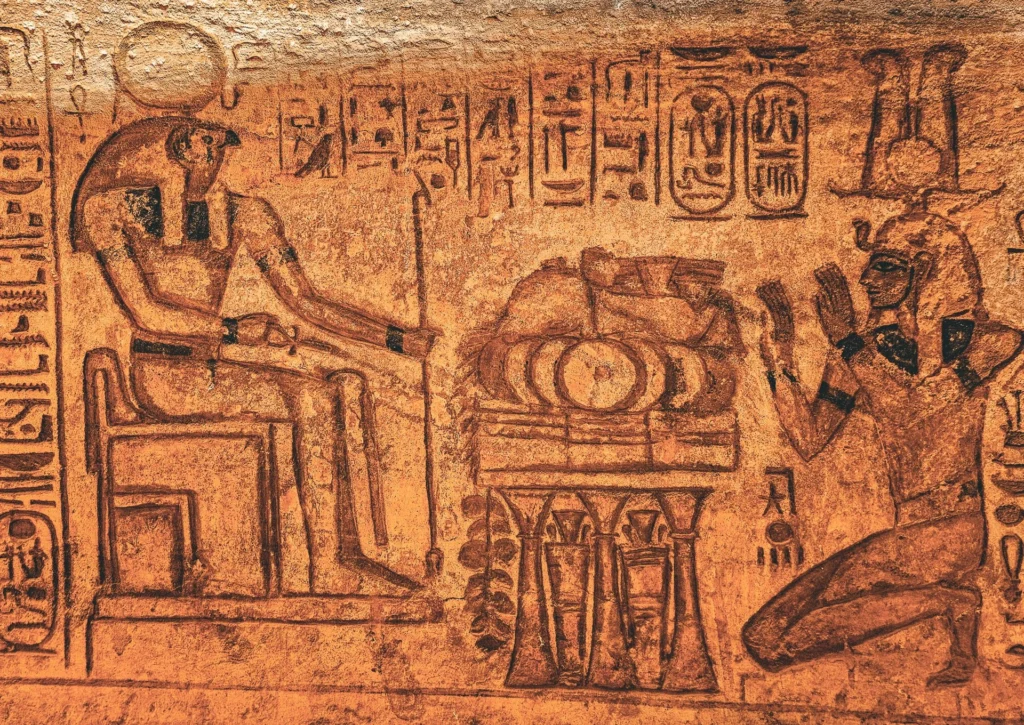
In Egyptian theology, the king was not merely a secular autocrat; he was the living Horus on earth, the son of the sun god Ra, and the sole ritual intermediary capable of upholding Ma’at — the cosmic order of truth, justice, and harmony — against Isfet (chaos). To administer the Two Lands, the New Kingdom pharaoh relied on two viziers (tjaty), one based at Memphis for Lower Egypt and one at Thebes for Upper Egypt, supported by overseers of the treasury, royal granaries, and cattle counts. Beneath them worked a literate bureaucracy of scribes trained in the Per-Ankh (“House of Life”), who recorded land surveys, court litigation, and tax assessments in cursive hieratic script on papyrus rolls and limestone ostraca.
No ruler projected this imperial ideology more ambitiously than Ramesses II (r. 1279–1213 BC), widely known in popular searches as Egypt Ramses the Great. Ruling for sixty-six years during the Nineteenth Dynasty, he constructed a new Delta capital at Pi-Ramesses, built the colossal rock-cut temples of Abu Simbel in Nubia and the Ramesseum mortuary complex at Thebes, and sired roughly a hundred sons and daughters. As Kenneth A. Kitchen documented in Pharaoh Triumphant: The Life and Times of Ramesses II (1982), the defining military test of his reign came in Year 5 (1274 BC) at the Battle of Kadesh on the Orontes River in Syria against the Hittite King Muwatalli II. Ambushed after believing false intelligence from captured scouts, Ramesses rallied his household guard until reinforcements arrived, turning a near-disaster into a tactical stalemate that he carved across temple pylons throughout Egypt as a personal triumph. Sixteen years later, in 1258 BC, Ramesses II and the Hittite monarch Hattusili III concluded the Egyptian-Hittite Peace Treaty — the world’s earliest surviving parity peace treaty whose text is preserved in both Egyptian hieroglyphs at Karnak and Akkadian cuneiform on clay tablets excavated at the Hittite capital of Hattusa (Boğazköy).
How the ancient economy of Egypt worked without coinage
Until the introduction of foreign Greek silver owls and the fourth-century BC gold stater (nefer-nub) in the Late Period, the ancient economy of Egypt functioned for nearly three thousand years without minted coins. As Barry J. Kemp explains in Ancient Egypt: Anatomy of a Civilization (2018), economic life operated through a combination of state redistribution and local barter priced against abstract units of account. The fundamental unit of value was the deben (standardised in the New Kingdom at approximately 91 grams of copper, silver, or gold), alongside the khar (a sack of grain equal to roughly 76.8 litres) and the seniu (equal to one-twelfth of a silver deben).
When villagers traded a wooden coffin, a donkey, or linen garments in a riverbank market, scribes priced the goods in copper deben and settled the balance using equivalent values of barley, emmer loaves, sesame oil, bronze tools, or woven cloth. At the macro-level, royal and temple estates — particularly the vast Domain of Amun at Karnak, which by the reign of Ramesses III controlled over 2,300 square kilometres of farmland and more than 80,000 personnel, as recorded in Papyrus Harris I — collected harvest taxes, stored grain in domed mud-brick silos, and paid state artisans, soldiers, and quarrymen in monthly rations of bread, beer, dried fish, and linen.
Daily life for the peasant majority (fellahin) revolved around the three four-month seasons of the agricultural calendar: Akhet (inundation, when flooded fields freed farmers for state construction corvée), Peret (emergence, the winter planting and growing season), and Shemu (low water, the spring harvest). While peasants lived in modest mud-brick village houses and subsisted on barley beer, flatbread, onions, lentils, and Nile catfish, Egyptian civil law granted free women a legal status unmatched in classical Greece: as Gay Robins showed in Women in Ancient Egypt (1993), Egyptian women could own, inherit, and bequeath real estate in their own names, initiate divorce, witness contracts, and testify in court without a male guardian.
Religion, tombs and how many pyramids are in Egypt
Egyptian religion pervaded every aspect of politics, medicine, and architecture, driving the evolution of royal burials from Early Dynastic mud-brick mastabas to Old Kingdom stone pyramids and New Kingdom rock-cut tombs.
Gods, mummification and the journey to the afterlife
Polytheism in ancient Egypt encompassed more than 1,500 named deities whose regional cults merged and evolved alongside political capitals. The Heliopolitan creation theology traced the cosmos from the primeval waters of Nun to the sun god Atum-Ra, while the Memphite theology credited the craftsman god Ptah with speaking the world into existence through heart and tongue. In the Middle and New Kingdoms, the local Theban god Amun fused with the solar deity to become Amun-Ra, king of the gods, while popular devotion centred on the Osirian myth cycle: the murder of the benevolent king Osiris by his brother Seth, his resurrection through the magic of his wife Isis, and his vindication by his son Horus.
Because Osiris became ruler of the underworld (Duat), Egyptians believed that survival after death required preserving the physical body so the deceased’s vital life-force (ka) and mobile personality (ba) could reunite as a transfigured spirit (akh). Embalmers perfected artificial mummification by removing the brain through the nostrils and placing the lungs, stomach, liver, and intestines inside four canopic jars guarded by the Four Sons of Horus, while leaving the heart inside the chest as the seat of intelligence and morality. Packing the body in dry natron salt (sodium carbonate and bicarbonate harvested from Wadi El Natrun) for forty days dehydrated the tissues before priests wrapped the corpse in resin-soaked linen bandages and protective amulets. In the Hall of Two Truths, illustrated in New Kingdom funerary scrolls known as the Book of Going Forth by Day (Book of the Dead), the god Anubis weighed the deceased’s heart against the ostrich feather of Ma’at: if the heart was lighter than or equal to the feather, the soul entered the Field of Reeds (Aaru); if heavy with sin, it was devoured by the monster Ammit.
Pyramids are in Egypt and why royal tombs moved underground
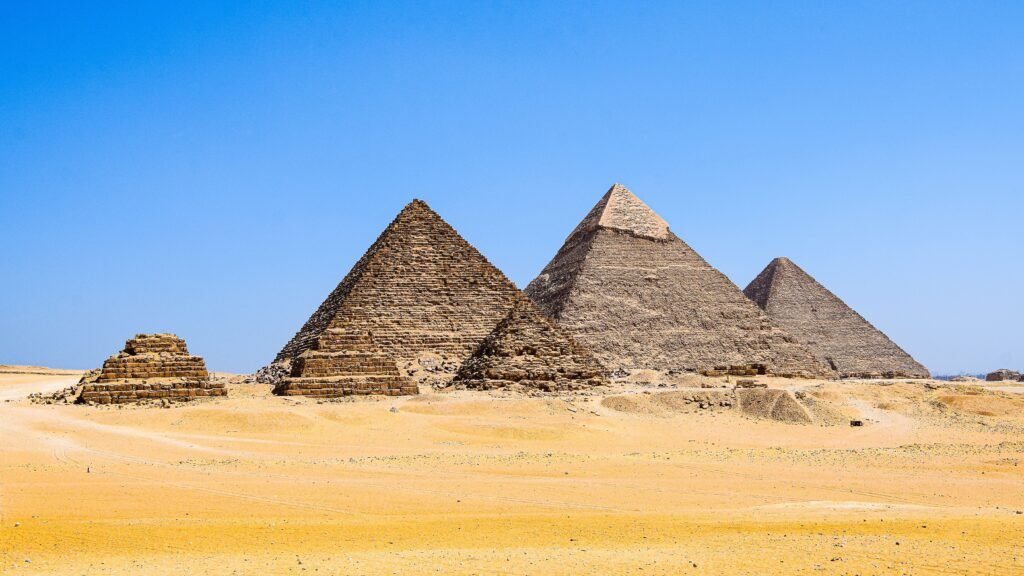
Visitors gazing at the Giza plateau often assume only three royal pyramids survive, raising the frequent search question of how many pyramids are in Egypt. As Mark Lehner catalogued in The Complete Pyramids (1997), archaeologists have identified between 118 and 138 ancient Egyptian pyramids built for kings and queens across a thousand-year span from the Third to the Seventeenth Dynasty (excluding the later steep-sided Kushite pyramids built further south in modern Sudan at El-Kurru, Nuri, and Meroë).
Monumental stone pyramid building began around 2650 BC at Saqqara, where the Third Dynasty chancellor and architect Imhotep stacked six diminishing limestone mastabas atop one another to create the 62-metre Step Pyramid of King Djoser. Under the Fourth Dynasty founder Sneferu (c. 2613–2589 BC), royal engineers experimented with true smooth-sided geometry at Meidum and Dahshur — building the Bent Pyramid and the Red Pyramid — before Sneferu’s son Khufu erected the Great Pyramid at Giza. Standing originally 146.6 metres (481 feet) high and assembled from roughly 2.3 million limestone and granite blocks averaging 2.5 tonnes each, Khufu’s monument was joined at Giza by the pyramids of his son Khafre (fronted by the Great Sphinx) and his grandson Menkaure. Fifth and Sixth Dynasty kings built smaller rubble-core pyramids at Abusir and Saqqara, carving the walls of their burial chambers (beginning with King Unas around 2345 BC) with the Pyramid Texts — the world’s oldest corpus of religious spells.
Because giant masonry pyramids acted as conspicuous beacons for tomb robbers during the First and Second Intermediate Periods, Eighteenth Dynasty pharaohs abandoned pyramid superstructures altogether. Beginning with Thutmose I around 1500 BC, New Kingdom monarchs separated their public mortuary temples on the Theban floodplain from their secret rock-cut burial chambers hollowed deep inside the arid limestone cliffs of the Valley of the Kings (Biban el-Muluk) on the west bank of Luxor.
Art, proportions and hieroglyphic scripts
Far from being decorative art for art’s sake, Egyptian painting and sculpture functioned as ritual machinery designed to sustain life eternally. Artists worked within a strict canon of proportions using an eighteen-square grid (standardized in the Middle Kingdom from the soles of the feet to the hairline) and an aspective representational code: to ensure the ka possessed a complete body in the afterlife, painters rendered the head, hips, legs, and feet in profile, while showing the eye and shoulders frontally.
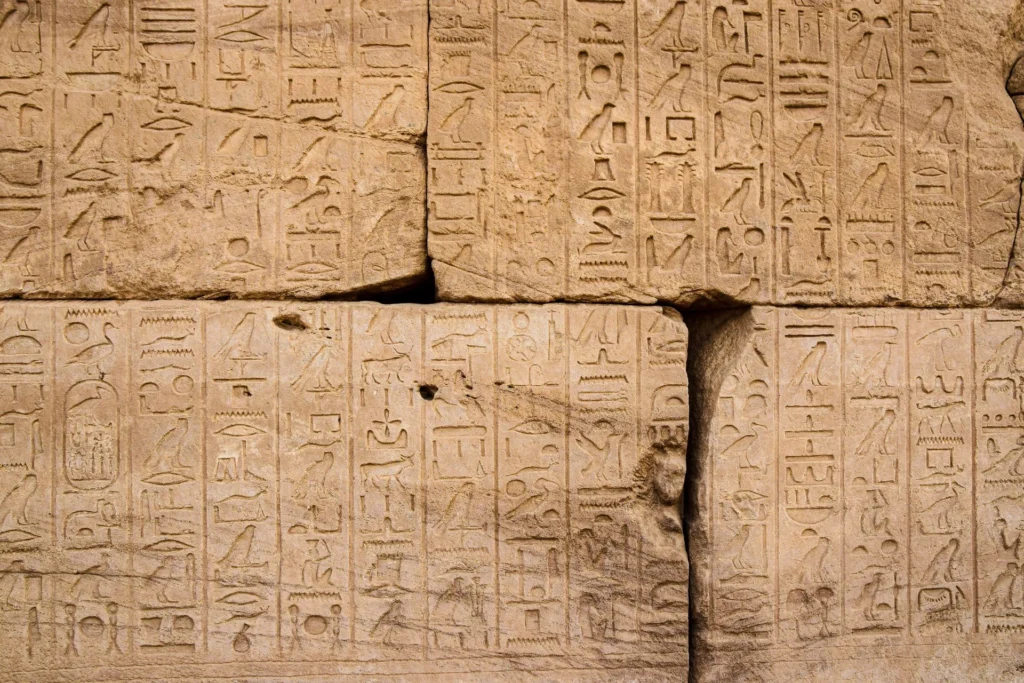
Alongside visual art stood four stages of the Egyptian language written across four distinct scripts. Monumental hieroglyphs (“sacred carvings”) combined phonetic signs (uniliteral, biliteral, and triliteral consonants), whole-word logograms, and silent determinative classifiers carved on temple walls and stelae. For everyday administration, letters, medical treatises (such as the Edwin Smith Surgical Papyrus), and mathematical handbooks (such as the Rhind Mathematical Papyrus), scribes used hieratic, a rapid cursive shorthand written with rush pens on papyrus. Around 650 BC, an even more abbreviated script called demotic replaced hieratic for legal and commercial business, before giving way in the Roman and Byzantine eras to Coptic, which wrote the final spoken stage of Egyptian using the Greek alphabet supplemented by seven demotic characters.
Late Period decline, foreign dynasties and the end of pharaonic rule
After the death of Ramesses III in 1155 BC, the New Kingdom fractured from within as Mediterranean trade networks collapsed during the Late Bronze Age collapse and Sea Peoples migrations, real grain prices spiked in Thebes, and systemic state-sanctioned tomb robberies stripped the royal necropolis of its gold bullion. By 1069 BC, Egypt entered the Third Intermediate Period (Twenty-First to Twenty-Fifth Dynasties): pharaohs ruled the Delta from Tanis while the High Priests of Amun governed Upper Egypt from Thebes as a military theocracy.
Over the next millennium, foreign powers repeatedly conquered the Nile Valley while adopting pharaonic titles and iconography. In the eighth century BC, Nubian rulers from the Kingdom of Kush (centred at Napata below the Fourth Cataract) led by Piye marched north and established the Twenty-Fifth (“Kushite”) Dynasty, reuniting Egypt and sponsoring an artistic renaissance modelled on Old Kingdom monuments before Neo-Assyrian armies under Esarhaddon and Ashurbanipal sacked Thebes in 663 BC. Following a brief native revival under the Twenty-Sixth Dynasty at Sais (664–525 BC), the Achaemenid Persian King Cambyses II conquered Egypt in 525 BC, ruling as the Twenty-Seventh Dynasty.
When Alexander the Great invaded the Persian Empire and entered Memphis unopposed in 332 BC, he was hailed as a liberator, visited the Oracle of Amun at Siwa Oasis, and founded the Mediterranean port city of Alexandria. After Alexander’s death in 323 BC, his Macedonian general Ptolemy I Soter seized Egypt and established the Ptolemaic Dynasty (305–30 BC). Governing from Alexandria through a Greek-speaking bureaucracy while funding traditional Egyptian temples at Edfu, Dendera, and Philae, the Ptolemies turned Egypt into the intellectual and grain-exporting powerhouse of the Hellenistic world. Yet dynastic civil wars and growing financial dependence on Rome eroded Ptolemaic sovereignty. When Queen Cleopatra VII — the only Ptolemaic monarch recorded to speak the native Egyptian language — allied with Mark Antony and lost the naval Battle of Actium in 31 BC against Octavian, the thirty-dynasty pharaonic tradition ended: once we trace how did Cleopatra die in August 30 BC, Octavian annexed Egypt as a personal imperial dependency of the Roman Empire.
What the Giza workers’ town, the Turin Strike Papyrus and the Rosetta Stone reveal
Three bodies of primary archaeological and textual evidence — the Fourth Dynasty workers’ settlement at Giza paired with Red Sea papyrus logbooks, a twelfth-century BC administrative strike scroll in Turin, and the trilingual Rosetta Stone in London — overturn the popular myths that slaves built the pyramids, that Egyptian workers were voiceless subjects, and that hieroglyphs were mystical picture-puzzles.
Paid pyramid builders at Giza and the first recorded strike at Deir el-Medina
The enduring popular belief that tens of thousands of whipped slaves built the Giza pyramids originated not in Egyptian records, but in fifth-century BC Greek travel storytelling by Herodotus (Histories 2.124–125) and twentieth-century Hollywood epics. Beginning in 1988, excavations directed by Mark Lehner and the Ancient Egypt Research Associates (AERA) at Heit el-Ghurab (“Wall of the Crow”), situated 400 metres south of the Great Sphinx, uncovered the planned royal city built for the workforce of Pharaohs Khafre and Menkaure. Far from a slave camp, Heit el-Ghurab contained long gallery barracks capable of sleeping 1,600 to 2,000 rotating conscripts, alongside industrial royal bakeries, copper-working shops, and massive animal slaughterhouses. Zooarchaeological analysis of tens of thousands of animal bones by Richard Meadow and Nerissa Russell revealed that the pyramid builders consumed prime beef, sheep, and goat slaughtered daily — roughly eleven cattle and thirty-seven sheep or goats per day — supplemented by protein-rich Nile fish, emmer bread, and beer, while skeletal remains buried in the adjacent workers’ cemetery showed healed fractures and successful cranial trepanation indicative of state medical care.
In 2013, a French-Egyptian mission directed by Pierre Tallet and Gregory Marouard at the Old Kingdom Red Sea harbour of Wadi el-Jarf discovered the oldest known inscribed papyri in the world, dating precisely to Year 27 of Pharaoh Khufu (c. 2560 BC). Published by the Institut français d’archéologie orientale (IFAO) in 2017, the Diary of Merer (Papyrus Jarf A and B) is the official daily logbook of a middle-ranking inspector named Merer who led a phyle (work gang) of roughly two hundred boatmen. Merer’s entries record hauling fine white casing limestone (r-au stone) from the Tura quarries on the east bank of the Nile by cargo boat across the inundated floodplain directly to Akhet-Khufu (“the Horizon of Khufu”, the Great Pyramid) over a ten-day round-trip cycle, reporting directly to Khufu’s half-brother and vizier Ankhkaf.
More than fourteen centuries later, during the New Kingdom, the skilled stonecutters, draughtsmen, and plasterers who carved the royal tombs in the Valley of the Kings lived in the walled state village of Deir el-Medina (Set-Ma’at, “The Place of Truth”). In Year 29 of Ramesses III (c. 1155 BC), administrative delays and wartime inflation interrupted the monthly grain deliveries from the Theban granaries. Preserved on the Turin Strike Papyrus (Papyrus Turin Cat. In 1880, it was housed in the Museo Egizio in Turin and edited by Alan H. Gardiner), the scribe Amennakhte recorded history’s first documented labour strike. On the tenth day of the second month of Peret, the artisans laid down their bronze chisels, marched past the guard posts shouting “We are hungry!”, and staged sit-ins behind the mortuary temples of Thutmose III and Seti I. When the vizier To and local temple officials tried to placate them with partial rations, the workers refused to return to the royal tomb until their full back-pay of emmer wheat and barley was delivered.
How the Rosetta Stone unlocked hieroglyphs and what remains debated
After the Roman Emperor Theodosius I closed non-Christian temples in the late fourth century AD, knowledge of how to read Egyptian scripts died out completely: the last known dated hieroglyphic inscription (the Graffito of Esmet-Akhom) was carved at the Temple of Isis at Philae on 24 August 394 AD, and the last demotic graffito followed in 452 AD. For the next fourteen centuries, following late antique treatises like Horapollo’s Hieroglyphica, European and Arab scholars mistakenly assumed every hieroglyph was a purely symbolic ideogram.
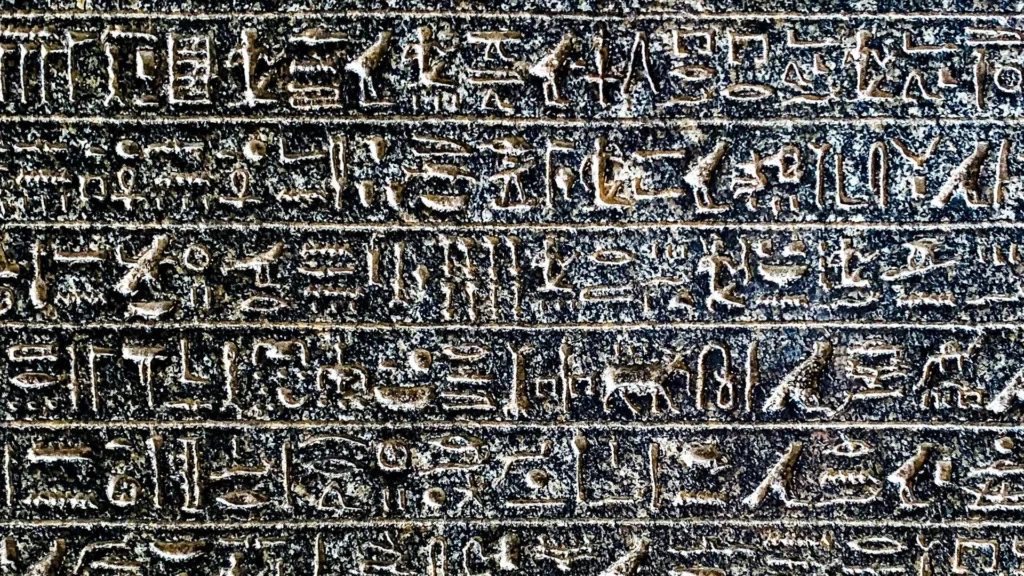
The breakthrough began in July 1799 during Napoleon Bonaparte’s campaign in Egypt, when French army engineer Pierre-François Bouchard spotted a dark granodiorite slab built into a medieval wall at Fort Julien near Rashid (Rosetta). Transferred to London under the Treaty of Alexandria in 1801, the Rosetta Stone (British Museum EA 24) carries a single priestly decree issued at Memphis on 27 March 196 BC celebrating the first anniversary of the coronation of the thirteen-year-old King Ptolemy V Epiphanes. Because the stone recorded the decree in three scripts — fourteen lines of formal hieroglyphs, thirty-two lines of everyday demotic, and fifty-four lines of Koine Greek — scholars could compare the known Greek text against the unknown Egyptian scripts. After the English polymath Thomas Young demonstrated that demotic mixed phonetic and ideographic signs and that royal names inside oval cartouches spelled foreign names phonetically, the French philologist Jean-François Champollion—drawing on his mastery of Coptic—proved in his September 1822 Lettre à M. Dacier (archived at the Bibliothèque nationale de France) that traditional Egyptian hieroglyphs were not mere symbols, but a complex hybrid writing system representing the spoken sounds of the Coptic-related Egyptian language.
Despite two centuries of decipherment and excavation, major problems in ancient Egypt chronology and state collapse remain actively debated. As Ian Shaw and Erik Hornung demonstrated in Ancient Egyptian Chronology (2006), absolute calendar dates before 664 BC can still shift by ten to thirty years between “High” and “Low” chronologies because scholars must reconcile fragmentary king-lists (such as the Turin King List) with contested heliacal risings of the star Sirius (Sopdet). Even high-precision radiocarbon models compiled by Christopher Bronk Ramsey and colleagues in Science (2010) and paired with ice-core markers for the Thera (Santorini) volcanic eruption leave a generation-wide debate over the exact accession dates of early Eighteenth Dynasty kings. Similarly, archaeologists continue to debate the relative weight of rapid climate aridification (the “4.2 kiloyear BP megadrought”) versus administrative decentralization in triggering the collapse of the Old Kingdom around 2181 BC.
Tracing ancient Egypt from the siltstone palette of Narmer around 3100 BC to the suicide of Cleopatra VII in 30 BC dismantling the cliché of a static, death-obsessed civilisation frozen in stone. Pharaonic society survived for three thousand years because its ecological contract with the Nile flood supported a resilient fiscal administration capable of absorbing foreign invasions, religious revolutions, and dynastic collapses. When we pair the royal colossi of Ramesses II with the cattle-bone middens of the Giza workers’ town, the logbooks of Inspector Merer, and the angry strike testimony of the Deir el-Medina tomb-makers, the monuments along the Nile cease to be mysterious relics of anonymous bondage and emerge as the work of literate, organised, and outspoken human communities.
References
Primary sources
- Alan H. Gardiner, ed., Ramesside Administrative Documents (London: Oxford University Press for the Griffith Institute, 1948), pp. 45–58 (“The Strike Papyrus”, Papyrus Turin Cat. 1880).
- Pierre Tallet, Les papyrus de la mer Rouge I: Le “journal de Merer” (Papyrus Jarf A et B), Mémoires publiés par les membres de l’Institut français d’archéologie orientale (MIFAO) 136 (Cairo: Institut français d’archéologie orientale, 2017).
- The Rosetta Stone (Decree of Memphis, Year 9 of Ptolemy V Epiphanes, 196 BC), granodiorite stele, Registration no. EA 24, The British Museum, London, accessed 29 October 2026, https://www.britishmuseum.org/collection/object/Y_EA24.
- Miriam Lichtheim, Ancient Egyptian Literature: A Book of Readings, 3 vols. (Berkeley: University of California Press, 1973–1980; new ed. 2006).
Secondary sources
- Ian Shaw, ed., The Oxford History of Ancient Egypt (Oxford: Oxford University Press, 2000; new ed. 2003).
- Barry J. Kemp, Ancient Egypt: Anatomy of a Civilization, 3rd ed. (London and New York: Routledge, 2018). DOI: 10.4324/9781351166485.
- Toby Wilkinson, The Rise and Fall of Ancient Egypt: The History of a Civilisation from 3000 BC to Cleopatra (London: Bloomsbury, 2010).
- Mark Lehner, The Complete Pyramids: Solving the Ancient Mysteries (London: Thames & Hudson, 1997).
- Mark Lehner, “The Pyramid Age Settlement of the Southern Mount at Giza,” Journal of the American Research Center in Egypt 39 (2002): 27–74. DOI: 10.2307/40001149.
- Pierre Tallet and Gregory Marouard, “The Harbor of Khufu on the Red Sea Coast at Wadi al-Jarf, Egypt,” Near Eastern Archaeology 77, no. 1 (2014): 4–14. DOI: 10.5615/neareastarch.77.1.0004.
- Kenneth A. Kitchen, Pharaoh Triumphant: The Life and Times of Ramesses II, King of Egypt (Warminster: Aris & Phillips, 1982).
- Gay Robins, Women in Ancient Egypt (Cambridge, MA: Harvard University Press, 1993).
- Richard Parkinson, Cracking Codes: The Rosetta Stone and Decipherment (London: British Museum Press, 1999).
- Christopher Bronk Ramsey, Michael W. Dee, Joanne M. Rowland, Thomas F. G. Higham, Stephen A. Harris, Fiona Brock, Anita Quiles, Eva Maria Wild, Ezra S. Marcus, and Andrew J. Shortland, “Radiocarbon-Based Chronology for Dynastic Egypt,” Science 328, no. 5985 (2010): 1554–1557. DOI: 10.1126/science.1189395.
Further reading (not drawn on for this article)
- Erik Hornung, Rolf Krauss, and David A. Warburton, eds., Ancient Egyptian Chronology, Handbook of Oriental Studies 83 (Leiden: Brill, 2006).
- Jaromir Malek, In the Shadow of the Pyramids: Egypt during the Old Kingdom (Norman: University of Oklahoma Press, 1986).
- Marc Van De Mieroop, A History of Ancient Egypt, 2nd ed. (Chichester: Wiley-Blackwell, 2021).