

The Roman Empire was the post-republican superstate that governed the Mediterranean basin, western Europe, and the Near East from the constitutional settlement of Augustus in 27 BC until the fall of its eastern capital, Constantinople, in 1453 AD. At its second-century height, it united between 50 million and 70 million inhabitants under a single legal, military, and monetary fiscal system that permanently shaped European and Near Eastern urban civilisation. Beyond the marble monuments of the capital, wooden ink tablets from Britain, sixth-century court chronicles, and modern palaeoclimate data reveal a frontier society far more literate, environmentally vulnerable, and resilient than textbook narratives suggest.
Key facts
- Dates: 27 BC (Principate established under Augustus) – 476 AD (deposition of the last western emperor in Italy) / 1453 AD (fall of Byzantine Constantinople to the Ottoman Empire)
- Capitals: Rome (from 27 BC); Milan (286–402 AD) and Ravenna (402–476 AD) in the West; Constantinople (330–1453 AD) in the East
- Key rulers: Augustus (r. 27 BC–14 AD), Trajan (r. 98–117 AD), Hadrian (r. 117–138 AD), Marcus Aurelius (r. 161–180 AD), Diocletian (r. 284–305 AD), Constantine I (r. 306–337 AD), Justinian I (r. 527–565 AD)
- Peak size and population: Approximately 5 million square kilometres across more than 40 provinces in 117 AD; estimated population of 50 million to 70 million (roughly one-fifth to one-quarter of humanity)
- Outcome: Western provinces fragmented into Germanic successor kingdoms in the fifth century AD; the eastern Roman state endured for another millennium until 1453 AD
From Republic to the Roman Empire: How big was the Roman Empire at its peak?
The Roman Empire emerged from the violent collapse of the Roman Republic in the first century BC and reached its maximum territorial extent of roughly 5 million square kilometres under Emperor Trajan in 117 AD. Stretching from the Clyde-Forth line in northern Britain to the Tigris River in Iraq, it remains the only state in history to control the entire coastline of the Mediterranean Sea (Mare Nostrum).
Rome had already conquered most of its Mediterranean provincial ring under the Republic, when senatorial magistrates commanded citizen armies that defeated Carthage, Macedon, and the Seleucid monarchy. Yet the wealth and military commands of empire tore the republican constitution apart. Following the assassination of Julius Caesar in 44 BC, thirteen years of civil war ended in 31 BC at the naval Battle of Actium, where Caesar’s adopted son Octavian defeated Mark Antony and annexed Ptolemaic Egypt after we ask how did Cleopatra die in Alexandria in 30 BC.
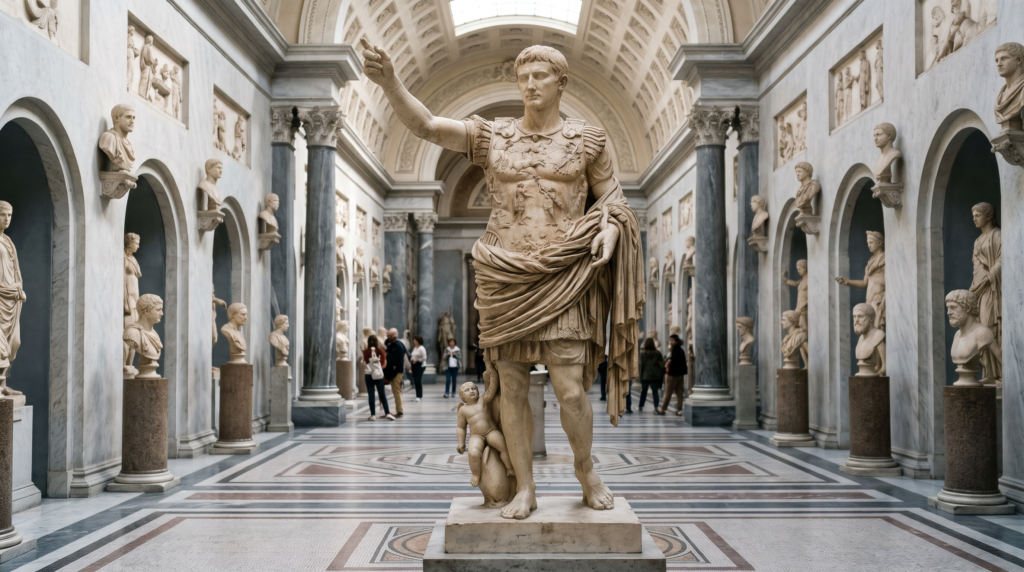
In January 27 BC, Octavian staged a formal transfer of emergency powers back to the Senate and People of Rome, receiving in return the honorific title Augustus and a ten-year proconsular command over the frontier provinces where the bulk of the legions stood. As Augustus boasted in his funerary inscription, the Res Gestae Divi Augusti (edited by P. A. Brunt and J. M. Moore from the surviving Latin and Greek text carved on the Temple of Rome and Augustus in Ankara), he claimed to excel all contemporaries in auctoritas (informal prestige) while holding no more official magistracies than his colleagues. In reality, by combining permanent tribunicia potestas (tribunician veto and legislative initiative) with supreme military command (imperium maius) and personal control of Egypt’s grain revenue, Augustus created an autocracy disguised as a restored republic — a system historians call the Principate.
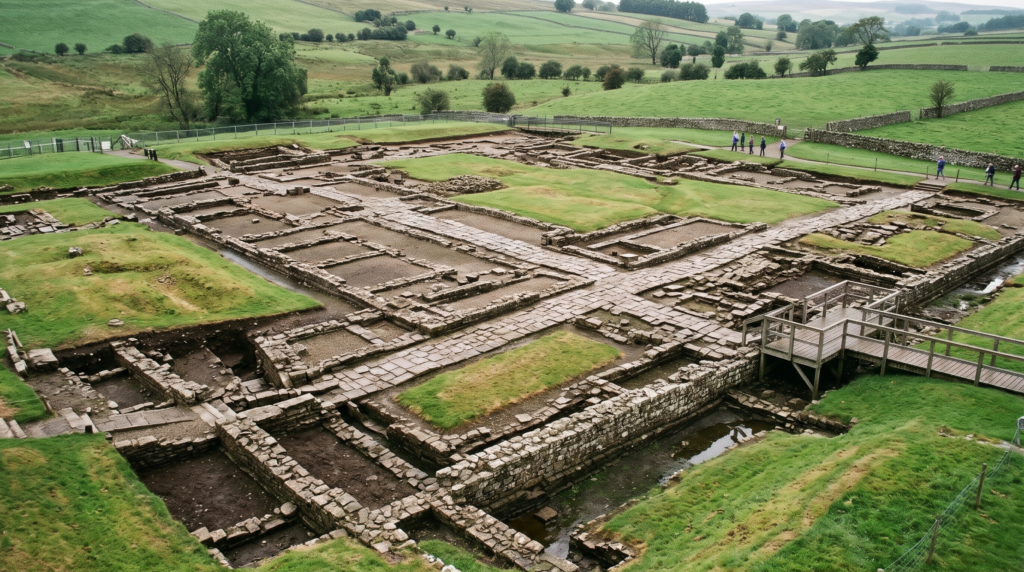
Over the next century and a half, Augustus and his Julio-Claudian, Flavian, and Antonine successors consolidated the empire’s frontiers along three great natural barriers: the Rhine and Danube rivers in Europe, the Sahara desert in North Africa, and the Euphrates watershed facing Parthia. Answering how big was the Roman Empire requires looking at both land area and demography. When Trajan annexed Dacia (modern Romania), Nabataea, Armenia, and Mesopotamia between 101 and 117 AD, imperial territory covered approximately 5 million square kilometres across forty-plus provinces. Demographic historians including Walter Scheidel estimate that this territory supported between 50 million and 70 million inhabitants by 160 AD, with the city of Rome itself housing roughly one million residents fed by state-subsidised grain shipments (annona) from Egypt and North Africa. Hadrian, succeeding Trajan in 117 AD, abandoned the exposed Mesopotamian conquests and marked the transition from limitless expansion to fixed linear defences, exemplified by the 118-kilometre stone wall begun across northern Britain in 122 AD.
Roman emperors, legions and the network of Roman roads
Imperial rule endured for centuries because the central government remained remarkably lean, relying on fewer than two hundred elite senatorial and equestrian administrators at any one time to supervise self-governing local city councils (curiae), backed by a standing professional army of roughly 300,000 to 400,000 soldiers and an all-weather network of Roman roads.
How Roman emperors governed the provinces
Throughout the Principate (27 BC–284 AD), Roman emperors did not govern through a vast salaried civil service, but through a system of responsive petition and local elite cooperation memorably analysed by historian Fergus Millar in The Emperor in the Roman World (1977). Millar showed that the emperor’s daily work consisted largely of answering letters, legal appeals, and embassies from provincial towns, guilds, and individual subjects. Across the Mediterranean, more than two thousand cities — from Ephesus and Antioch in the Greek-speaking East to Lugdunum and Lepcis Magna in the Latin West — collected their own direct land and poll taxes, maintained local markets and courts, and funded civic bathhouses, aqueducts, and amphitheatres in exchange for Roman legal privileges and senatorial career paths.
Succession remained the structural weakness of imperial governance. Because the Principate never established a formal law of primogeniture, power passed through a volatile mix of dynastic bloodlines, strategic adoption, Praetorian Guard coups, and frontier army proclamations. Under the Julio-Claudians (27 BC–68 AD) and Flavians (69–96 AD), palace conspiracies and the civil wars of 69 AD (“the Year of the Four Emperors”) exposed how quickly legions could unmake a ruler. By contrast, during the Nerva-Antonine dynasty (96–192 AD), childless emperors from Nerva to Antoninus Pius adopted capable military and senatorial heirs — Trajan, Hadrian, Antoninus Pius, and Marcus Aurelius — producing eighty-four years of internal political stability before Marcus Aurelius reverted to biological succession with his son Commodus.
Legions, Roman roads and the imperial economy
The coercive backbone of the state was the professional standing army created by Augustus, which absorbed between half and two-thirds of annual state revenues. Under the early Empire, the military comprised 25 to 30 citizen legions of roughly 5,000 heavy infantrymen each, matched by an equal number of non-citizen auxiliary infantry and cavalry (auxilia) recruited from provincial subjects. Crucially, the state incentivised service through legal status: legionaries signed on for twenty-five years in exchange for regular pay and a retirement discharge bonus, while auxiliary soldiers received full Roman citizenship for themselves and their children upon completing twenty-five years of service, recorded on bronze military diplomas that survive across Europe.
To deploy those forces and move official dispatches via the imperial courier service (cursus publicus), military engineers constructed roughly 80,000 to 100,000 kilometres of paved and gravelled Roman roads linking Rome to every frontier garrison. Built with cambered stone or gravel surfaces over layered foundations and flanked by drainage ditches and inscribed stone milestones (miliaria), trunk highways such as the Via Appia in Italy, the Via Egnatia across the Balkans, and the Stanegate along the British frontier allowed legions to march thirty kilometres a day in any weather. As Colin Adams demonstrated in The Cambridge Companion to the Roman Economy (2012), these overland highways did not operate in isolation; they fed directly into river barges on the Rhine, Rhône, Nile, and Tiber and connected with low-cost Mediterranean sea lanes.
Archaeological proxies compiled by Oxford’s Roman Economy Project confirm that this integrated transport network generated a level of trade and manufacturing unmatched in western Eurasia until the seventeenth century. Greenland ice-core measurements of atmospheric lead pollution — a byproduct of smelting silver for Roman denarii in Spanish mines — alongside over a thousand dated Mediterranean shipwrecks and giant mounds of discarded Spanish olive-oil amphorae at Monte Testaccio in Rome, show peak commercial integration between the first century BC and the second century AD.
Society, slavery and the religious transformation of the empire
Roman society was rigidly hierarchical yet legally permeable, resting on a sharp statutory division between freeborn citizens (ingenui), freed former slaves (libertini), and enslaved human property (servi), while gradually evolving from civic polytheism to state-sponsored Nicene Christianity.
Hierarchy, slavery and universal citizenship
At the apex of the social pyramid stood approximately six hundred senators, whose rank required a minimum property qualification of one million sesterces, followed by tens of thousands of equestrian (equites) knights and municipal councillors (decuriones) who owned at least 400,000 and 100,000 sesterces respectively. Beneath this propertied elite lived the urban plebs, rural smallholders, and tenant farmers (coloni). Yet as Mary Beard emphasises in SPQR: A History of Ancient Rome (2015), Rome differed fundamentally from classical Greek city-states in its willingness to expand its citizen body. Former enemies, provincial magistrates, and discharged auxiliary soldiers were steadily absorbed into the Roman legal fold. This centuries-long process culminated in 212 AD when Emperor Caracalla issued the Constitutio Antoniniana (Edict of Caracalla), granting Roman citizenship to nearly all free inhabitants of the empire — a measure that simultaneously unified Roman civil law and expanded the pool of citizens liable to the five-percent inheritance tax used to pay the army.
Beneath the free population, Rome functioned as an institutional slave society. In her study Slavery in the Roman World (2010), Sandra R. Joshel notes that enslaved men, women, and children — captured in frontier wars, kidnapped by pirates, exposed as infants, or born to enslaved mothers (vernae) — worked every sector of the economy, from brutal chain-gangs in Iberian silver mines and Sicilian latifundia estates to highly educated Greek pedagogues, physicians, and imperial financial secretaries (familia Caesaris). Walter Scheidel estimates that enslaved people accounted for roughly 15 to 25 percent of the population of Roman Italy (around 1 to 1.5 million individuals) and between 7 and 13 percent of the empire’s total population (roughly 5 million to 8 million people). Unlike modern transatlantic plantation slavery, Roman bondage was not racially defined, and formal manumission (manumissio) was common among urban skilled slaves: a freedman (libertus) gained civic freedom and his future children became full freeborn Roman citizens, commemorated on thousands of proudly carved funerary reliefs along Italian roads.
From civic polytheism to imperial Christianity
For its first three centuries, the empire practised an inclusive, contractual polytheism in which state security depended on maintaining the pax deorum (“peace of the gods”) through correct public sacrifice and divination. Provided provincial subjects paid taxes and offered sacrifice for the wellbeing of the emperor and the state gods, Roman authorities tolerated hundreds of local deities, mystery cults of Isis and Mithras, and through special statutory exemption, ancestral Jewish monotheism. That equilibrium broke down cleanly only when religious movements rejected civic pacification or sparked revolt, most destructively during the three Jewish-Roman Wars (66–73 AD, 115–117 AD, and the Bar Kokhba revolt of 132–135 AD), which ended with the destruction of the Jerusalem Temple and the refounding of the city as the Roman colony of Aelia Capitolina.
Christianity began in the 30s AD as an apocalyptic Jewish movement in Roman Judaea following the crucifixion of Jesus of Nazareth under the prefect Pontius Pilate. Traveling along urban trade routes through the missionary networks of Paul of Tarsus and Greek-speaking synagogues, Christian communities refused to sacrifice to the traditional gods or the imperial genius, triggering sporadic local prosecutions — reflected in Pliny the Younger’s famous correspondence with Trajan from Bithynia around 112 AD — and later empire-wide persecutions under Decius (250 AD) and Diocletian (303–311 AD). The religious trajectory reversed between 312 and 380 AD: after converting to Christianity and issuing the Edict of Milan in 313 AD, Emperor Constantine I patronised the church and convened the First Council of Nicaea in 325 AD to standardise Christian orthodoxy, before Theodosius I made Nicene Christianity the official state religion through the Edict of Thessalonica in 380 AD and outlawed public pagan blood sacrifice.
Why did the Roman Empire fall? Crisis, division and Byzantium
Answering why did the Roman Empire fall requires separating the fifth-century fiscal and military disintegration of the western Latin provinces (completed between 376 and 476 AD) from the survival of the wealthier, better-fortified eastern Roman state centered on Constantinople, which endured until 1453 AD.
The Third-Century Crisis and the Tetrarchy
The classical Principate nearly collapsed between 235 and 284 AD during the Third-Century Crisis, when the assassination of Severus Alexander triggered fifty years of military anarchy. More than twenty-six claimant emperors seized the purple as mutinous frontier armies fought civil wars, the aggressive Sasanian Persian Empire under Shapur I captured Emperor Valerian in 260 AD, the silver content of the antoninianus coin plunged below two percent, and breakaway regimes formed the Gallic Empire in the west and the Palmyrene Empire under Queen Zenobia in the east.
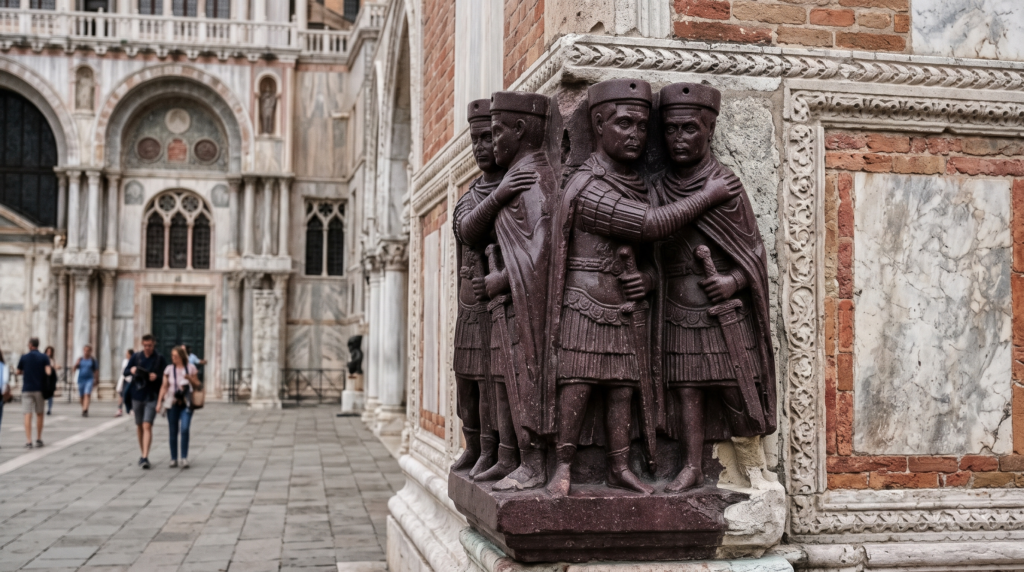
Dalmatian cavalry commander Diocletian (r. 284–305 AD) stabilised the state by replacing the veiled autocracy of the Principate with the Dominate — an overtlyceremonial, bureaucratic monarchy. Recognising that one man could not simultaneously defend the Rhine, the Danube, and the Syrian desert, Diocletian instituted the Tetrarchy in 293 AD, dividing administrative responsibility between two senior emperors (Augusti) and two junior colleagues (Caesars), each governing from a strategic frontier capital (Nicomedia, Milan, Trier, and Sirmium) rather than distant Rome. He doubled the number of smaller provinces to roughly a hundred, separated civil governors from military commanders (duces), and introduced a standardised land and head tax assessment (capitatio-iugatio). Constantine I (r. 306–337 AD) reunited the empire militarily, introduced the pure gold solidus coin that anchored Mediterranean commerce for seven centuries, and in 330 AD dedicated a new eastern capital at Byzantium — renamed Constantinople — sited at the defensible maritime crossroads of the Bosphorus.
How the Western Empire disintegrated
As Peter Heather argued in The Fall of the Roman Empire: A New History of Rome and the Barbarians (2005), the fourth-century empire recovered its administrative vigour, and the western collapse of the fifth century was driven primarily by exogenous geopolitical shocks combined with fatal losses of tax revenue. Beginning in the 370s AD, the westward advance of the nomadic Huns across the Pontic steppe pushed large Gothic coalitions across the lower Danube. In 378 AD, an eastern Roman field army led by Emperor Valens was annihilated by Gothic forces at the Battle of Adrianople, forcing Theodosius I to settle autonomous Gothic federate troops inside imperial borders.
Between 405 and 409 AD, mixed coalitions of Vandals, Alans, Suevi, and Burgundians crossed the Rhine and overran Gaul and Hispania, while Alaric’s Visigoths sacked the city of Rome for three days in August 410 AD. The decisive fiscal blow fell between 429 and 439 AD, when Geiseric led the Vandals across the Strait of Gibraltar and conquered North Africa, capturing Carthage in 439 AD. Losing Africa deprived the western court at Ravenna of its richest grain- and tax-producing provinces. Without African tax revenues to pay regular legions, western emperors became puppets of Germanic generals-in-chief (magistri militum) such as Ricimer and Orestes, while Britain, Spain, and Gaul fractured into Anglo-Saxon, Visigothic, Burgundian, and Frankish kingdoms.
The Byzantine continuation and the legacy of Rome
In his archaeological study The Fall of Rome and the End of Civilization (2005), Bryan Ward-Perkins demonstrated that the collapse of the western Roman state was not a painless cultural transition, but triggered a sharp material contraction in western Europe: mass-produced wheel-turned pottery, brick and tile roofing, and small bronze coinage vanished in post-Roman Britain and shrank dramatically across Italy and Gaul, reducing rural building dimensions and livestock sizes to prehistoric levels.
Yet the Roman Empire did not end in the fifth century. The eastern half, possessing a larger population, unbroken sea walls at Constantinople, and the untaxed agricultural wealth of Egypt, Syria, and Anatolia, weathered the fifth-century migrations intact. Its citizens never called themselves “Byzantines” — a term popularised by sixteenth-century Western scholars — but Rhomaioi (Romans), and their state Basileia ton Rhomaion. Under Justinian I (r. 527–565 AD), eastern generals Belisarius and Narses reconquered North Africa from the Vandals and Italy from the Ostrogoths, while legal commissioners led by Tribonian compiled the Corpus Juris Civilis (529–534 AD), the codification of Roman law that later formed the foundation of modern continental European civil law systems. Even after seventh-century Arab conquests stripped away Syria, Egypt, and North Africa, the medieval Roman state survived until the Ottoman siege and fall of Constantinople on 29 May 1453.
What the Vindolanda tablets, 476 AD chronicles and palaeoclimate data reveal
Beyond the elite literary histories of Tacitus, Suetonius, and Edward Gibbon, three bodies of modern evidence — the anaerobic ink tablets from Vindolanda on the northern British frontier, sixth-century eastern chronicles, and high-resolution palaeoclimate and ancient-DNA records — overturn common assumptions about everyday Roman literacy, the meaning of 476 AD, and the ecological fragility of imperial power.
Voices from the Vindolanda frontier and the non-event of 476 AD
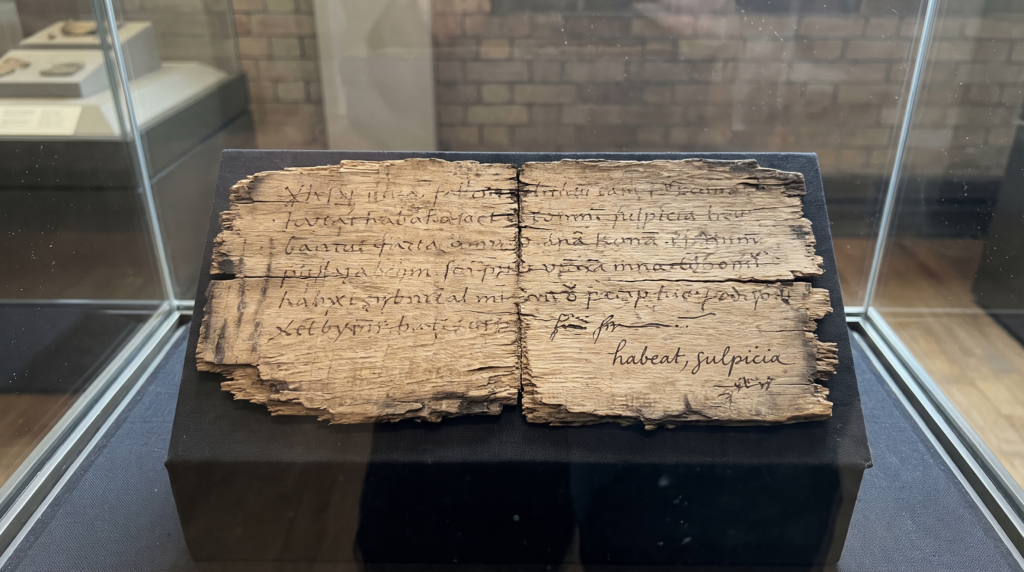
For generations, historians knew the Roman frontier army primarily through idealised treatises like Vegetius or carved stone tombstones. Beginning in 1973, excavations directed by Robin Birley in the waterlogged, oxygen-free clay layers beneath the pre-Hadrianic timber forts at Vindolanda in Northumberland recovered more than 1,700 thin wooden leaf-tablets written in carbon ink between roughly 85 and 130 AD. Deciphered and edited by Alan K. Bowman and J. David Thomas (Tabulae Vindolandenses), these routine documents belong to the auxiliary garrisons of the Ninth Cohort of Batavians and the First Cohort of Tungrians, recruited from the Rhineland and modern Belgium.
The tablets reveal a remarkably bureaucratic and literate frontier community. Tablet 154, a daily strength report for the First Cohort of Tungrians commanded by Julius Verecundus, records that out of 752 men on the roll (including 6 centurions), 456 were absent on detached duties across Britain, while of the 296 remaining at the fort, 31 were unfit for duty — 15 sick, 6 wounded, and 10 suffering from eye inflammation. Personal correspondence shows officers’ families and ordinary soldiers writing in fluent Latin cursive: Tablet 291 preserves Claudia Severa’s affectionate invitation to her friend Sulpicia Lepidina, wife of prefect Flavius Cerialis, to attend her birthday party on 11 September, featuring the earliest known surviving Latin lines penned by a woman’s own hand. Another tablet (Tablet 346) records a correspondent sending a soldier a parcel of woollen socks (udones), two pairs of sandals, and two pairs of underpants (subligariorum), while Tablet 164 refers disparagingly to the local north Britons as Brittunculi (“wretched little Britons”).
Just as Vindolanda replaces Hollywood legionary stereotypes with real administrative paperwork, sixth-century chronicles dismantle the textbook myth that the world changed overnight on 4 September 476 AD when the Germanic commander Odoacer deposed the teenage western emperor Romulus Augustulus in Ravenna. In a landmark 1983 article in Chiron and his 1995 commentary on the Chronicle of Marcellinus Comes, historian Brian Croke demonstrated that contemporaries in Italy barely registered 476 AD as a rupture. Odoacer did not abolish the Roman state; instead, the Roman Senate sent the imperial vestments to the eastern Emperor Zeno in Constantinople, declaring that one monarch sufficed for both halves of the empire, and Odoacer governed Italy as a Roman patrician while consuls, senatorial estates, and municipal tax collectors continued as before. The notion that the Western Roman Empire “fell” in 476 AD was actually formulated over forty years later in Constantinople around 518–519 AD by the Illyrian court official Marcellinus Comes, whose Latin chronicle entry for 476 AD declared that the western empire started by Augustus had perished with “Augustulus” — an ideological argument designed to legitimise Justinian’s looming reconquest of Italy.
How plague and climate research reshaped the decline debate
The most intense twenty-first-century debate over Roman history centres on the role of environmental instability and pandemic disease. In The Fate of Rome: Climate, Disease, and the End of an Empire (2017), historian Kyle Harper synthesised tree-ring series, speleothems, ice cores, and bioarchaeological data to argue that Rome’s rise coincided with the Roman Climatic Optimum (roughly 200 BC to 150 AD) — a phase of warm, wet, and unusually stable Mediterranean weather with minimal volcanic forcing that allowed agrarian surpluses to expand into marginal lands.
According to Harper, the very commercial connectivity created by Roman roads and shipping lanes turned the empire into an incubator for intercontinental pathogens as the climate cooled and destabilised after 150 AD. Soldiers returning from Mesopotamia in 165 AD introduced the Antonine Plague (likely smallpox, described clinically by the physician Galen), which swept the empire for fifteen years and killed an estimated 7 million to 10 million people (roughly 10 percent of the population). A century later, the Plague of Cyprian (c. 249–262 AD) compounded the military crisis of the third century, before a cluster of massive volcanic eruptions in 536 and 540 AD triggered the Late Antique Little Ice Age and preceded the arrival of the first confirmed bubonic pandemic (Yersinia pestis), the Plague of Justinian, at Pelusium in 541 AD.
Yet this environmental determinism remains fiercely contested. In a 2018 multi-part critique in History Compass, John Haldon and colleagues — alongside subsequent ancient-DNA and papyrological studies by Mordechai and Eisenberg (2019) — argued that Egyptian tax papyri, coin circulation, and pollen profiles do not show uniform demographic collapse across the empire after 165 AD or 541 AD, insisting that military fiscal structures, elite tax evasion, and geopolitical rivalry with Sasanian Persia and Germanic coalitions remained the primary drivers of imperial transformation.
Tracing the Roman Empire across fifteen centuries — from Augustus’s carefully staged republican restoration in 27 BC to the Ottoman cannon breaching Constantinople’s walls in 1453 AD — reveals why simple morality tales of decadence and collapse fail to explain its history. Rome survived for so long because it paired brutal military coercion and mass chattel slavery with an unusually adaptable legal framework that turned conquered provincials in Spain, Syria, Africa, and Illyria into Roman citizens, senators, and eventually emperors. When we look past the grand marble rhetoric of the capital to the ink-stained leave requests from Vindolanda, the belated ideological invention of 476 AD in sixth-century Constantinople, and the disputed paleoclimatic record, the empire appears not as a static monument that suddenly shattered, but as a vast, interconnected ecosystem constantly renegotiating the limits of pre-modern state power.
References
Primary sources
- Augustus, Res Gestae Divi Augusti: The Achievements of the Divine Augustus, ed. P. A. Brunt and J. M. Moore (Oxford: Oxford University Press, 1967). DOI: 10.1093/actrade/9780198317722.book.1.
- Alan K. Bowman and J. David Thomas, eds., The Vindolanda Writing-Tablets (Tabulae Vindolandenses II) (London: British Museum Press, 1994).
- Alan K. Bowman and J. David Thomas, eds., The Vindolanda Writing-Tablets (Tabulae Vindolandenses III) (London: British Museum Press, 2003).
- Marcellinus Comes, The Chronicle of Marcellinus: A Translation and Commentary, trans. and ed. Brian Croke, Byzantina Australiensia 7 (Sydney: Australian Association for Byzantine Studies, 1995; repr. Leiden: Brill, 2017). DOI: 10.1163/9789004344631.
Secondary sources
- Mary Beard, SPQR: A History of Ancient Rome (London: Profile Books, 2015).
- Fergus Millar, The Emperor in the Roman World (31 BC–AD 337) (London: Duckworth, 1977).
- Alan K. Bowman, Life and Letters on the Roman Frontier: Vindolanda and Its People (London: British Museum Press, 1994).
- Walter Scheidel, ed., The Cambridge Companion to the Roman Economy (Cambridge: Cambridge University Press, 2012). DOI: 10.1017/CCO9781139030199.
- Sandra R. Joshel, Slavery in the Roman World (Cambridge: Cambridge University Press, 2010).
- Peter Heather, The Fall of the Roman Empire: A New History of Rome and the Barbarians (Oxford: Oxford University Press, 2005).
- Bryan Ward-Perkins, The Fall of Rome and the End of Civilization (Oxford: Oxford University Press, 2005).
- Brian Croke, “A.D. 476: The Manufacturing of a Turning Point,” Chiron 13 (1983): 81–119.
- Kyle Harper, The Fate of Rome: Climate, Disease, and the End of an Empire (Princeton, NJ: Princeton University Press, 2017).
Further reading (not drawn on for this article)
- Edward Gibbon, The History of the Decline and Fall of the Roman Empire, ed. David Womersley, 3 vols. (London: Allen Lane, 1994).
- Chris Wickham, Framing the Early Middle Ages: Europe and the Mediterranean, 400–800 (Oxford: Oxford University Press, 2005).
- Anthony Kaldellis, The New Roman Empire: A History of Byzantium (Oxford: Oxford University Press, 2023).