

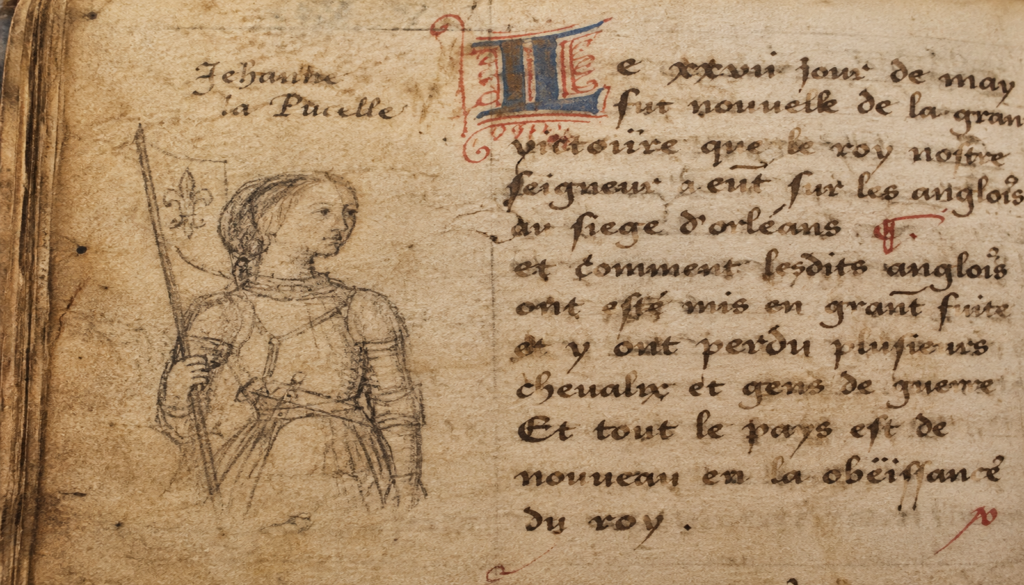
Joan of Arc entered besieged Orléans on 29 April 1429 and helped lift the nearly seven-month English blockade nine days later on 8 May, not by replacing veteran commanders across medieval France, but by compelling cautious captains to storm isolated English bastilles (1, 2, 4). Contemporary municipal accounts and sworn eyewitness depositions show she shared tactical authority with Jean de Dunois while supplying the aggressive momentum that broke the Siege of Orléans (1, 3, 5).
How popular myth portrays Joan of Arc at Orléans
Popular biographies, school histories, and feature films routinely present Joan of Arc as a solitary teenaged general who took supreme command of a starving city and routed a massive English army in nine days (4, 8). In this familiar version, Orléans was sealed behind an impenetrable ring of English fortifications, its garrison paralysed until a seventeen-year-old peasant from Domrémy arrived in white armour, overruled every nobleman in the war council, and devised the tactical plan that saved the Valois monarchy (4, 6).
This heroic shorthand compresses a seven-month artillery and counter-fortification struggle into a nine-day miracle (4, 7). Following the catastrophic French defeat at the Battle of Agincourt in 1415 and the Anglo-Burgundian Treaty of Troyes in 1420, which disinherited the Dauphin Charles, the Loire River marked the strategic frontier of Valois territory (8, 9). Yet modern military historians including Kelly DeVries and Stephen W. Richey emphasise that Orléans was neither completely cut off before 29 April 1429 nor rescued by divine improvisation alone (4, 6). Treating the relief solely as a personal command performance obscures the artillery network, municipal financing, and veteran captains that made the four-day assault sequence possible (4, 7).
How chroniclers and trial witnesses shaped the legend
The belief that the Maid acted as sole commander grew out of two distinct bodies of fifteenth-century writing: Valois partisan chronicles written immediately after 1429 and the testimony collected for her posthumous Nullification Trial between 1455 and 1456 (2, 3, 9). Within weeks of the English retreat on 8 May 1429, Valois treatises and poems — culminating in Christine de Pizan’s Ditié de Jehanne d’Arc (completed 31 July 1429) — celebrated the relief as proof that God had chosen Charles VII as rightful king over his Anglo-Lancastrian rival (3, 8). To maximise the theological weight of the victory, Valois polemicists downplayed the logistical preparations at Blois and credited the outcome to an untaught girl guided by heavenly voices (5, 8).
Twenty-five years later, after Charles VII recovered Normandy and sought to overturn the heresy verdict of the 1431 Rouen condemnation trial, inquisitorial commissioners interviewed Joan’s surviving companions-in-arms, including Jean de Dunois (the Bastard of Orléans), Duke Jean II of Alençon, and her squire Jean d’Aulon (2, 3). As Pierre Duparc’s critical edition of the Procès en nullité demonstrates, these noble witnesses testified under oath to prove Joan’s orthodoxy and divine inspiration, frequently highlighting her prophetic warnings and fearless banner-bearing while glossing over routine staff decisions (2, 8). Nineteenth-century romantic historians later fused those hagiographical recollections with the civic pride of the Journal du siège d’Orléans, turning a collaborative military operation into a solo command narrative (1, 4).
A late fifteenth-century miniature from Martial d’Auvergne’s Vigiles de Charles VII (c. 1484) depicts the fortified walls and artillery exchanges at Orléans during the 1428–1429 blockade (Bibliothèque nationale de France, Département des Manuscrits, Français 5054, fol. 53r).
What the Siege of Orléans records actually show
The primary administrative and eyewitness record of the campaign is the Journal du siège d’Orléans, compiled from contemporary town accounts and edited by Jules Quicherat (1847) and by Paul Charpentier and Charles Cuissard (1896), alongside the trial transcripts translated by Craig Taylor and Daniel Hobbins (1, 3, 9). These documents show that when Thomas Montagu, Earl of Salisbury, began the Siege of Orléans on 12 October 1428, the English lacked the manpower to surround the entire circuit of walls (1, 4). Even after William de la Pole, Earl of Suffolk, and John Talbot took command following Salisbury’s death from cannon fire in October 1428, the English garrisoned roughly 3,500 to 5,000 troops spread across disconnected earth-and-timber bastilles concentrated to the west and south, leaving the north-eastern approaches open (1, 4, 7).
Because that gap remained unsealed, French detachments and supply convoys entered and exited Orléans repeatedly throughout the winter of 1428–1429 (1, 4). When Joan of Arc marched from Blois with a heavily armed royal relief convoy at the end of April 1429, Dunois deliberately guided her main force along the south bank to avoid the strongest English earthworks, ferrying her into the city upstream via Chécy on the evening of 29 April while the army returned to Blois to cross properly (1, 3, 4).
What changed between 29 April and 8 May was operational tempo and troop morale (4, 6). Dunois and the veteran captains — La Hire, Poton de Xaintrailles, and Gilles de Rais — initially intended to use the reinforced garrison for cautious containment, whereas Joan insisted on immediate, direct assaults against individual English strongpoints before they could mutually reinforce one another (2, 3, 4).
| Date (May 1429) | Engagement at Orléans | Operational Decision and Outcome |
| 29 April – 3 May | Entry of supply convoys | Dunois ferries Joan and provisions in via Chécy; the main royal relief army arrives from Blois on 4 May without English interception (1, 4). |
| 4 May | Storming of Bastille Saint-Loup | French forces attack the isolated eastern English fort; Joan joins the assault and helps capture the work, securing the eastern river approach (1, 3, 4). |
| 6 May | Capture of the Augustins | French troops cross to the south bank, abandon the outer island fort of Saint-Jean-le-Blanc, and storm the fortified Augustinian monastery (1, 4). |
| 7 May | Assault on the Tourelles | Against the caution of several captains, Joan leads a day-long escalade of the bridgehead boulevard; despite a bolt wound to her shoulder, she returns at dusk as Dunois orders the final attack and townsfolk burn the drawbridge behind Commander William Glasdale (1, 3, 4). |
| 8 May | English withdrawal | Talbot and Suffolk array their remaining western forces in battle order, then abandon the siege lines after the French hold their ground (1, 4). |
Before marching with the relief convoy from Blois to Orléans, Joan was examined by royal councillors and theologians at Chinon and Poitiers, an episode illustrated around 1484 in Martial d’Auvergne’s Vigiles de Charles VII (Bibliothèque nationale de France, Français 5054, fol. 55v).
Why weaponry and command in medieval France remain debated
Even with the trial depositions and municipal ledgers in hand, historians disagree over the precise balance between charismatic leadership and gunpowder technology in medieval France (4, 7, 8). In his 1996 study of gunpowder weaponry during the campaign, Kelly DeVries demonstrated that Orléans possessed one of the heaviest urban artillery parks in fifteenth-century Europe, comprising at least 71 large wrought-iron bombards and couleuvrines manned by paid master gunners such as Jean de Montesclère (1, 7). These civic guns battered the timber palisades of the Tourelles and fired incendiary projectiles long before the final escalade on 7 May (1, 7).
The exact chain of command inside the French war councils remains equally contested because the witnesses of 1455–1456 remembered events through the lens of Joan’s vindication (2, 8). In his 1456 deposition, Dunois credited Joan’s arrival with turning English offensive confidence into defensive paralysis, famously stating that before she arrived 200 Englishmen could rout 800 or 1,000 royal soldiers, whereas afterwards 400 or 500 Frenchmen could confront the entire English host (2, 3). Yet squire Jean d’Aulon and Dunois also confirmed that the captains sometimes concealed operational routes from her — as on 29 April when they marched along the Sologne bank instead of the Beauce bank — and that Dunois retained formal authority over troop deployments and municipal coordination (2, 4, 6). Because the original Poitiers theological examination register is lost and English muster rolls for the final week at Orléans survive only in fragments, historians cannot reconstruct exact casualty figures or verify whether Suffolk’s council had already decided to abandon the siege if the Tourelles fell (4, 5).
French men-at-arms and crossbowmen storm the English fortifications at Orléans in May 1429, as depicted in the Vigiles de Charles VII (Bibliothèque nationale de France, Département des Manuscrits, Français 5054, fol. 57v).
Reading the Journal du siège d’Orléans alongside the trial depositions replaces a cartoon of solitary command with a more plausible military partnership (1, 2, 4). Joan of Arc did not invent French artillery tactics or displace professional commanders like Dunois, La Hire, and Xaintrailles, who organised the river crossings and coordinated the civic militia (4, 6, 7). Instead, she solved the psychological crisis that had paralysed Valois armies since Agincourt: by refusing to accept a war of passive attrition and returning to the Tourelles ditch even after taking an arrow wound above the breast, she forced professional soldiers to press home assaults they had previously judged impossible (2, 3, 4).
References
Primary sources
- Paul Charpentier and Charles Cuissard, eds., Journal du siège d’Orléans, 1428–1429, augmenté de plusieurs documents notamment des comptes de ville de 1429–1431 (Orléans: H. Herluison, 1896); first edited in Jules Quicherat, ed., Procès de condamnation et de réhabilitation de Jeanne d’Arc, dite la Pucelle, Tome IV (Paris: Jules Renouard, 1847), pp. 94–202.
- Pierre Duparc, ed., Procès en nullité de la condamnation de Jeanne d’Arc, 5 vols. (Paris: Klincksieck, 1977–1988).
- Craig Taylor, ed. and trans., Joan of Arc: La Pucelle: Selected Sources (Manchester: Manchester University Press, 2006).
Secondary sources
- Kelly DeVries, Joan of Arc: A Military Leader (Stroud: Sutton Publishing, 1999).
- Kelly DeVries, “A Woman as Leader of Men: Joan of Arc’s Military Career,” in Fresh Verdicts on Joan of Arc, ed. Bonnie Wheeler and Charles T. Wood (New York: Garland Publishing, 1996), pp. 3–18.
- Stephen W. Richey, Joan of Arc: The Warrior Saint (Westport, CT: Praeger, 2003).
- Kelly DeVries, “The Use of Gunpowder Weaponry by and against Joan of Arc During the Hundred Years War,” War & Society 14, no. 1 (1996): 1–15. DOI: 10.1179/072924796791200889.
- Helen Castor, Joan of Arc: A History (London: Faber & Faber, 2014).
- Daniel Hobbins, trans. and ed., The Trial of Joan of Arc (Cambridge, MA: Harvard University Press, 2005).
Further reading (not drawn on for this article)
Philippe Contamine, Olivier Bouzy, and Xavier Hélary, Jeanne d’Arc: Histoire et dictionnaire (Paris: Robert Laffont, 2012).
Colette Beaune, Jeanne d’Arc (Paris: Perrin, 2004).
Deborah A. Fraioli, Joan of Arc and the Hundred Years War (Westport, CT: Greenwood Press, 2005).